
Certified Radon Testing & Mitigation in Manlius, NY
Licensed, insured, and local. Serving Manlius and all of Onondaga County — an EPA Radon Zone 1 area.
Radon Mitigation & Testing in Manlius, NY
Manlius anchors the affluent eastern side of Onondaga County — the Fayetteville-Manlius corridor — and it sits squarely in EPA Radon Zone 1, the highest-risk designation for indoor radon. There’s a geological reason radon deserves particular attention on the east side: this part of the county sits over limestone and dolostone bedrock, and limestone-region soils are frequently associated with elevated radon as the gas migrates up through fractures and glacial cover into home foundations. Manlius pairs that geology with a housing mix of historic village colonials, established mid-century neighborhoods, and newer high-end construction — a wide range of foundations, all of which can test high.
Certified radon testing and mitigation is available throughout Manlius, including the village, the Fayetteville-Manlius school district neighborhoods, and surrounding developments. Higher-value homes here often have large finished basements and complex, multi-level foundations, which call for carefully designed mitigation rather than a one-size-fits-all install. Certified professionals assess the full foundation and design a system that reduces radon across the whole footprint.
Why Manlius Homes Test High for Radon
The bedrock beneath Manlius is unusual enough that geologists named a formation after the town. The Manlius Limestone, a Devonian-age carbonate unit, is exposed and studied throughout this part of eastern Onondaga County, and it sits alongside the Onondaga Limestone that forms the escarpment running east toward Cazenovia. For radon purposes, the significant characteristic of both units is not what they contain but how they break.
Carbonate rock dissolves. Slightly acidic groundwater moving through limestone widens joints and bedding planes over long periods, producing solution channels, enlarged fractures, and in places genuine karst features. The plunge-pool lakes at Clark Reservation and the meromictic lakes at Green Lakes are surface expressions of the same dissolution processes at work in this landscape.
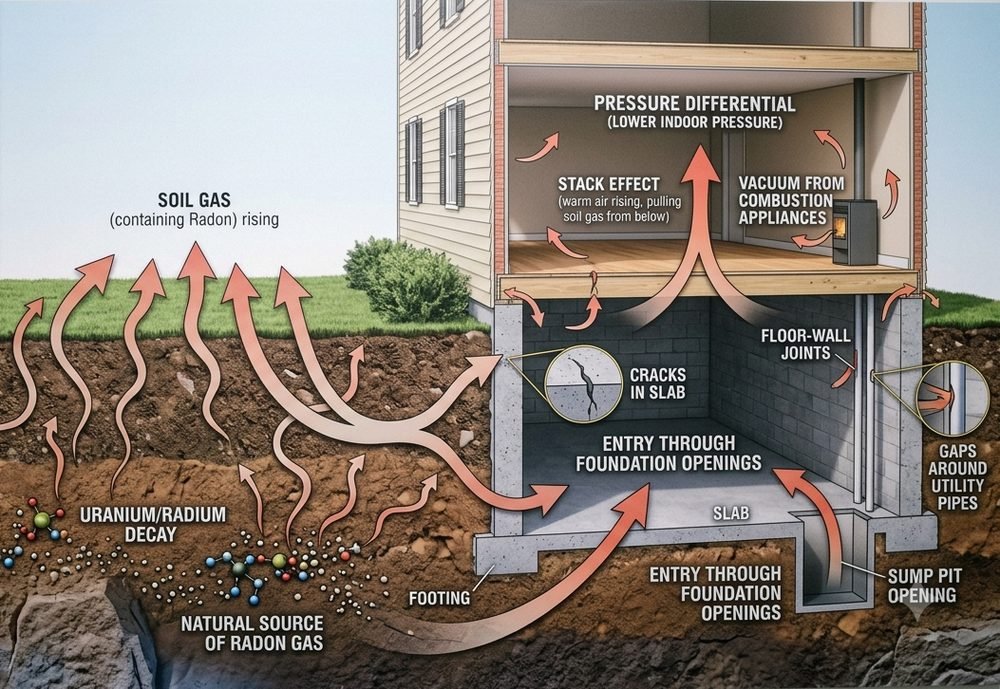
That matters because soil gas follows open pathways. Radon produced by radium decay deep in the rock does not have to diffuse slowly through dense material; in a channeled limestone system it can travel considerable distances along fractures before reaching the soil beneath a foundation. This is why Manlius homes can produce high readings even where surface soils appear shallow and unremarkable.
How Common Is Elevated Radon Around Manlius?
Roughly half of the homes tested across Onondaga County come back at or above the EPA action level of 4.0 pCi/L. That statistic is the most useful one for a Manlius homeowner deciding whether testing is worth the trouble, because it means a coin flip is a reasonable prior expectation rather than a remote possibility.
The county average basement concentration reported by the Onondaga County Health Department is 8.1 pCi/L, and the county holds the EPA Radon Zone 1 designation. Statewide, the New York State Department of Health estimates about 18 percent of homes exceed 4.0 pCi/L in basement screening, which places Onondaga County at close to triple the New York average.
County-level statistics cannot tell you what any particular house on Fayette Street or in the Fayetteville-Manlius district will measure. Fractured limestone produces notably inconsistent results over short distances, and neighboring homes on similar lots can differ substantially depending on where fractures happen to run. Testing is the only way to resolve that.
Manlius Housing Stock and Radon Entry Points
Manlius housing spans a wider range than most Onondaga County suburbs. The village contains substantial nineteenth-century stock, some of it stone-founded, alongside the postwar and contemporary subdivisions that grew up around the Fayetteville-Manlius school district. Newer construction in this market tends toward larger footprints than the county norm.
Footprint size has direct consequences for radon work. A sprawling ranch or a large colonial with an attached three-car garage may sit on a slab that is discontinuous beneath, divided by footings or by separate pours. A single suction point that adequately depressurizes a 1,200 square foot basement may leave the far corner of a 2,800 square foot footprint largely untouched. Multiple suction points are more common here than in tighter housing stock.
The terrain adds another factor. Much of the Manlius area sits on sloped ground descending from the escarpment, which has produced a high proportion of walkout and daylight basements. A walkout lower level is fully finished living space in many of these homes, with one wall above grade and three below. That configuration is comfortable to live in and complicates radon behavior, because the below-grade walls remain in contact with soil gas while the above-grade wall changes how air moves through the level.
Common entry points remain the same as anywhere else: the perimeter floor-wall joint, slab cracks and control joints, sump pits without sealed lids, and gaps around plumbing penetrations. In older village properties with stone foundations, the whole wall functions as an entry point rather than any single opening.
Radon Mitigation in Manlius
Active sub-slab depressurization is the proven solution — sealed vent piping and a specialized fan exhausting radon safely above the roofline, engineered around larger or multi-zone foundations where needed. Most installs are completed in a day. Cost depends on the home’s foundation type and system complexity — we’ll give you an exact figure in a free, no-obligation quote., and complex homes may fall at the higher end.
Larger Manlius homes frequently need more than one suction point, and determining how many requires diagnostic work rather than guesswork. A contractor can drill a small test hole and measure the pressure field extension beneath the slab, which shows how far the vacuum actually reaches through the material below. Systems designed without that measurement are the ones that fail their post-installation retest.
Walkout configurations offer a practical advantage on the routing side. The exposed lower-level wall often permits a clean exterior run, with the pipe carried up the side of the house and terminated above the roofline, avoiding the interior chase work that finished basements elsewhere require.
Where a portion of the lower level sits over crawl space rather than slab, a sealed membrane may be needed across that section, tied into the same fan and vent stack. Mixed-foundation homes are common in this part of the county and are the main reason quotes here vary more than they do in uniform subdivisions.
Radon Testing in Manlius
Continuous radon monitors deliver certified, tamper-resistant results in roughly 48 hours — fast enough for the real-estate inspection windows common in this active market, and important under New York’s disclosure requirements.
In a walkout or daylight basement, device placement should reflect how the space is actually used. The detector belongs in the finished, occupied portion rather than tucked into a mechanical area, and it should sit away from the walkout door where outdoor air exchange is greatest and would bias the reading low.
Closed-house conditions are harder to maintain in homes with walkout doors, since the lower level often functions as a secondary entrance to the yard. Anyone testing a Manlius home with a walkout should plan the test window for a period when that door can stay shut.
Selling a Manlius Home
The Fayetteville-Manlius market moves on school district demand, and buyers in that market tend to be well informed and thorough during inspection. Radon testing is a routine request rather than an occasional one.
New York Property Condition Disclosure Act requires sellers to report known radon results and any mitigation on the disclosure statement. Given how variable results are across fractured limestone, a seller who tests early has real information to work with instead of discovering a high number days before closing.
Areas We Serve Around Manlius
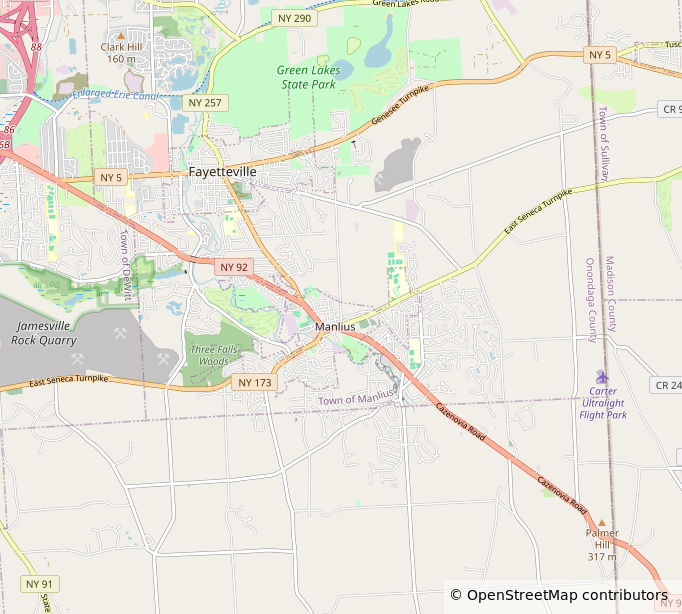
We provide radon testing and mitigation is available throughout the town and village of Manlius, including Fayetteville, Minoa, Kirkville, and the neighborhoods along Fayette Street, Highbridge Road, and East Seneca Turnpike, as well as properties near Green Lakes State Park. We also serve neighboring DeWitt and the city of Syracuse.
Frequently Asked Questions
Why is radon a concern in Manlius specifically?
Manlius is in Onondaga County (EPA Zone 1) and sits over limestone bedrock, a geology often associated with elevated radon. Testing is strongly recommended.
Do larger Manlius homes cost more to mitigate?
Complex or multi-level foundations can fall at the higher end of the cost range. We estimate before work.
Do you serve the Fayetteville-Manlius area?
Yes — the village and surrounding F-M neighborhoods.
Serving Manlius and nearby DeWitt, Syracuse, and the eastern Onondaga County towns.
Helpful reading for Manlius homeowners: radon in well water, what a mitigation system looks like, and seasonal radon variation in Central New York.