
Certified Radon Testing & Mitigation in Syracuse, NY
Licensed, insured, and local. Serving Syracuse and all of Onondaga County — an EPA Radon Zone 1 area.
Radon Mitigation & Testing in Syracuse, NY
Syracuse sits in the heart of Onondaga County — an EPA Radon Zone 1 area, the highest-risk designation for indoor radon. From the historic homes of the Near West Side and Strathmore to the mid-century neighborhoods of Eastwood and the newer developments on the city’s edges, radon can be elevated in any Syracuse home regardless of age or style. Certified professionals who provide radon testing, mitigation, and system repair throughout the city and the surrounding metro.
Why Radon Is a Concern in Syracuse
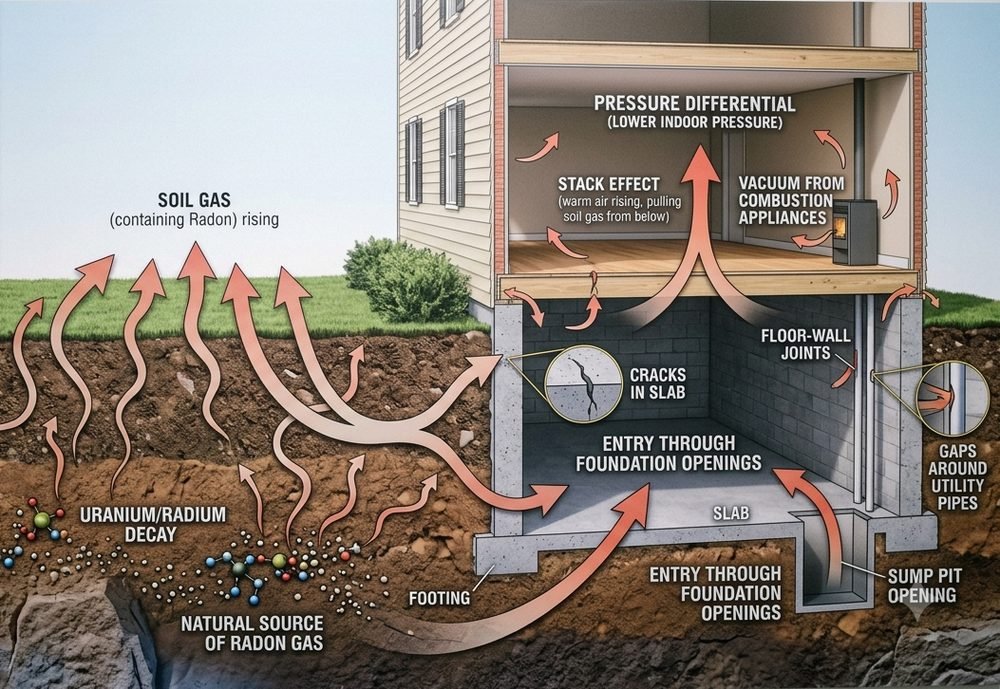
Central New York’s geology is the reason radon deserves attention here. The region’s glacial deposits sit over sedimentary and limestone bedrock, creating natural pathways for radon gas to migrate up from the soil and accumulate in basements and lower levels. Syracuse’s older housing stock — with fieldstone foundations, stone cellars, sump pits, and settling cracks — offers plenty of entry points, while newer full-basement construction channels soil gas directly toward the slab. The only way to know your home’s level is to test.
Syracuse was built on salt, and the geology that produced the brine industry is the same geology that produces the radon problem. The city sits above the Salina Group, a sequence of Silurian shale, dolostone, gypsum, and salt-bearing beds. Those units contain uranium in trace amounts, and uranium decays through radium to radon. The gas migrates upward along bedding planes and fractures until it reaches the soil beneath buildings.
Layered over that bedrock is a complicated surface geology. The city occupies the floor and walls of a glacial trough, with the Onondaga Creek and Ley Creek valleys cutting through unconsolidated sediment of widely varying depth and permeability. Neighborhoods on the valley floor sit over deep, often fine-grained fill. Neighborhoods on the surrounding hillsides, including the University area, Strathmore, and the higher ground toward Onondaga Hill, sit much closer to bedrock.
That contrast produces real differences in radon behavior within the city limits. Where bedrock lies close beneath a basement floor, soil gas has a short and direct route indoors. Where deep sediment intervenes, the gas moves more slowly and less predictably. Syracuse is not one radon environment but several, which is why citywide generalizations are less useful here than in the surrounding towns.
A further factor is specific to older cities. Syracuse has an extensive network of aging sewer laterals, utility trenches, and abandoned service connections running beneath its streets and into its buildings. Backfilled trenches are more permeable than the undisturbed ground around them, and they frequently function as preferential pathways carrying soil gas toward and into foundations.
Radon Levels Measured Across Onondaga County
Radon measurements collected across Onondaga County show an average basement concentration of 8.1 pCi/L, according to the Onondaga County Health Department. The EPA action level is 4.0 pCi/L, so the county average sits at more than double the threshold at which corrective action is recommended. Close to half of homes screened countywide exceed that action level.
Statewide, the New York State Department of Health estimates roughly 18 percent of homes have basement screening levels above 4.0 pCi/L. Onondaga County therefore runs at approximately three times the New York average, and the county carries the EPA Radon Zone 1 designation reserved for the highest predicted indoor levels.
Within the city, the variation described above means these county figures should be read as a floor for concern rather than a forecast. A home in Eastwood and a home in the Valley can differ substantially, and the only number that describes your house is the one measured in it.
Syracuse Housing Stock and Radon Entry Points
Syracuse housing is older than that of any surrounding community, and age is the dominant variable for radon entry. Large portions of the city were built before 1940, and in neighborhoods such as the Near West Side, the North Side, Tipperary Hill, and much of the Valley, pre-1920 construction is common.
Housing of that era typically has fieldstone or rubble foundations laid up with lime mortar. These walls are porous by construction rather than by deterioration, and a century of freeze-thaw cycling has widened the gaps that were always there. Rather than one identifiable crack to seal, the entire wall functions as a distributed entry surface.
Many older Syracuse basements also have partial or entirely unpaved floors. Where a slab exists it is often thin, poured directly on soil, and cracked. Where it does not, bare earth is in direct contact with basement air, which is the single highest-transfer condition radon can find in a residential building.
The city also contains a large stock of two-family and multi-family housing, much of it converted from single-family homes. Basements in these buildings frequently house shared mechanical systems and laundry, meaning tenants from multiple units spend time in the lowest and highest-concentration level of the structure. For landlords, that turns radon from a personal question into a tenant health consideration.
Newer construction exists in pockets, particularly in Eastwood and along the eastern edge of the city, and those homes have sound poured basements with the conventional entry points: the perimeter floor-wall joint, control joints, sump pits, and plumbing penetrations.
Radon Testing in Syracuse
We use continuous radon monitors for fast, tamper-resistant results in about 48 hours. Testing is essential for any Syracuse home that hasn’t been checked in the last few years, and for any home being bought or sold — New York addresses radon on its Property Condition Disclosure Statement, so results matter in a real-estate transaction. A professional short-term test is an affordable, one-time cost.
Testing an older Syracuse home requires more attention to placement than testing a suburban ranch. In a house with a partially finished or partially paved basement, the detector belongs in the area representing normal occupancy, not in the cleanest corner. If the basement contains laundry, mechanicals, and storage that household members use regularly, that is occupied space for testing purposes.
In two-family and multi-family buildings, the lowest occupied level of each dwelling unit should be considered, not only the shared basement. A first-floor apartment directly above an unpaved basement can carry a meaningfully different concentration than the unit above it.
Closed-house conditions can be harder to maintain in dense city housing where windows are used for ventilation and where units have separate entrances. Planning the test window around a period when the building can stay closed produces a result worth acting on.
Radon Mitigation in Syracuse
If your home tests at or above the EPA action level of 4.0 pCi/L, active sub-slab depressurization is the proven fix — a sealed vent and specialized fan that draws radon from beneath the foundation and safely exhausts it above the roofline. Most systems are installed in a single day, and we retest afterward to confirm the result. Most Syracuse-area mitigation costs depend on foundation type, home size, and system complexity.
Sub-slab depressurization remains the primary approach where an adequate slab exists. In older Syracuse homes, the more common situation is that the slab is thin, partial, or absent, and the system has to be designed around what is actually there rather than around what is typical.
Where a basement has a dirt floor or an unpaved section, the standard remedy is a sealed membrane laid across the exposed soil and connected to the same fan and vent stack. This is more labor than a conventional slab installation and it is the main reason quotes for older city properties come in above suburban figures.
Fieldstone foundation walls introduce a second consideration. Because the wall itself is permeable, depressurizing only beneath the floor may leave a significant entry route untouched. Interior parging, sealing, or in some cases a separate wall-cavity system can be needed alongside the slab work.
Venting also takes more planning in dense neighborhoods. The discharge point must terminate above the roofline and at an adequate distance from windows and from neighboring structures, which is a straightforward requirement on a suburban lot and a genuine design constraint on a narrow city parcel with close-set houses.
Selling a Syracuse Home
New York Property Condition Disclosure Act requires sellers of residential property to complete a statement reporting known radon test results and any mitigation work performed.
For Syracuse sellers, the practical value of testing early is larger than elsewhere in the county because the likely remedy is more variable. Discovering during the inspection period that a home needs membrane work over an unpaved basement, rather than a routine slab system, is a materially different negotiation than discovering it with time in hand.
For landlords and multi-family owners, a documented test and, where needed, a documented system is increasingly something prospective tenants and buyers ask about directly.
Certified, Licensed & Insured Professionals
Radon work in New York should be performed by professionals certified through the National Radon Proficiency Program (NRPP) or the National Radon Safety Board (NRSB) — the two EPA-recognized certification bodies. New York’s Department of Health maintains a list of certified radon mitigation contractors. Always confirm your provider is certified, licensed, and insured before work begins.
Serving Syracuse & the Surrounding Towns
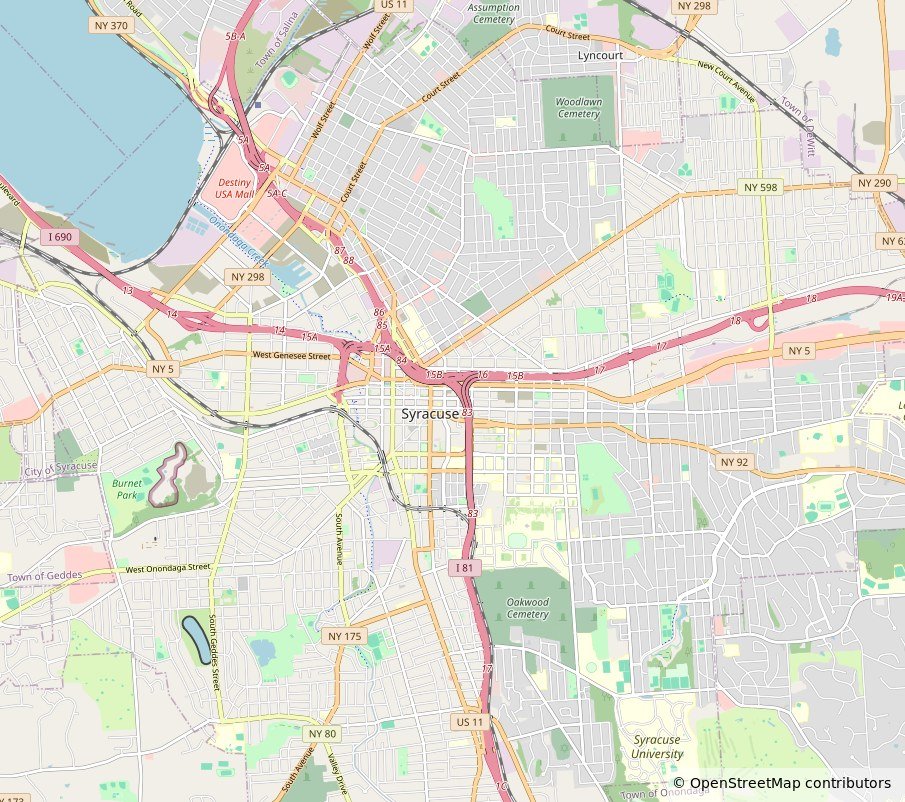
Beyond the city itself, we serve the surrounding Onondaga County communities including Cicero, Liverpool, Baldwinsville, Camillus, Manlius, and DeWitt. Wherever you are in the Syracuse metro, certified radon testing and mitigation is a phone call away.
Helpful reading for Syracuse homeowners: what to do if your test comes back high, radon mitigation cost in Syracuse, and radon levels by zip code.
We provide radon testing and mitigation throughout the city of Syracuse, including Eastwood, Strathmore, the Valley, Tipperary Hill, the University area, the North Side, the Near West Side, Sedgwick, Salt Springs, and Onondaga Hill. We also serve the surrounding communities of DeWitt, Liverpool, Camillus, and Manlius.
Frequently Asked Questions
Why do older Syracuse homes often test higher for radon?
Much of the city was built before 1940, and homes of that era typically have fieldstone or rubble foundations laid with lime mortar. Those walls are porous by construction rather than by damage, so the entire wall acts as an entry surface. Many older Syracuse basements also have thin, cracked slabs or unpaved sections where soil is in direct contact with basement air.
Does a dirt-floor basement need a different kind of radon system?
Yes. Sub-slab depressurization requires a slab to depressurize. Where a basement has a dirt floor or an unpaved section, a sealed membrane is laid across the exposed soil and connected to the same fan and vent stack. This takes more labor than a standard slab installation, which is why quotes for older city properties often run higher than suburban ones.
Can radon levels vary between Syracuse neighborhoods?
Considerably. Neighborhoods on the valley floor sit over deep unconsolidated sediment, while hillside areas such as Strathmore, the University area, and Onondaga Hill sit much closer to bedrock, giving soil gas a shorter route indoors. A result from one part of the city is not a reliable guide to another.
What does radon mitigation cost in Syracuse?
Cost depends on foundation type and system complexity, with testing an affordable one-time cost. Older city homes needing membrane work over unpaved basements or treatment of fieldstone walls sit toward the upper end. We provide a free estimate after assessing the property.
Am I required to test a rental property in Syracuse?
New York does not currently require radon testing in residential rental properties. The Property Condition Disclosure Act applies to sales, requiring sellers to report known radon results and any mitigation. Many Syracuse landlords test anyway, since shared basements in two-family and multi-family buildings are occupied space for laundry and mechanicals.