
Certified Radon Testing & Mitigation in Baldwinsville, NY
Licensed, insured, and local. Serving Baldwinsville and all of Onondaga County — an EPA Radon Zone 1 area.
Radon Mitigation & Testing in Baldwinsville, NY
Baldwinsville — “B’ville” — straddles the Seneca River in northwestern Onondaga County, spanning the towns of Lysander and Van Buren. Like the rest of the county, it’s an EPA Radon Zone 1 community, where indoor radon is predicted to average above the EPA action level. B’ville is a study in contrasts for radon: the large, master-planned Radisson community brings extensive newer construction with full basements, while the historic village center and surrounding rural roads hold much older housing stock with fieldstone foundations and crawl spaces. Both can test high.
Certified radon testing and mitigation is available throughout Baldwinsville — from the newer Radisson and Whispering Oaks developments to older homes near the village and the river. Newer full-basement homes here are built into glacial-till soils that channel soil gas directly toward the slab; older homes bring their own entry points through cracks, sumps, and unsealed crawl spaces. Certified professionals design the mitigation system around your specific foundation.
Why Baldwinsville Homes Test High for Radon
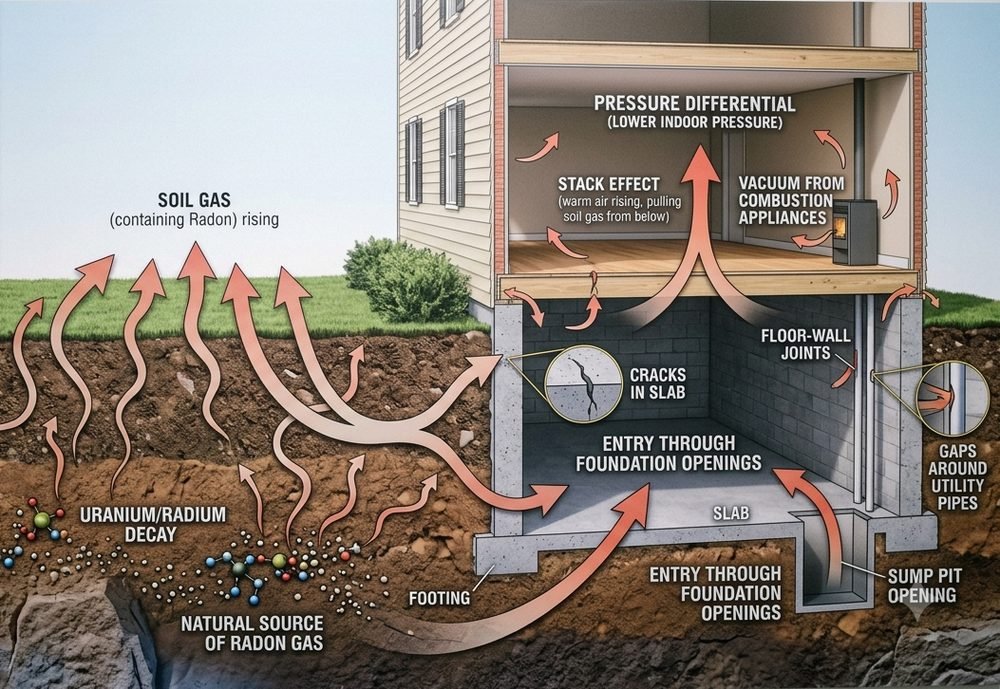
Baldwinsville straddles the Seneca River in the towns of Lysander and Van Buren, and the ground here is a mix that works against homeowners when it comes to radon. Beneath the surface soils lies the same Silurian-age shale and dolostone sequence that runs across northern Onondaga County, formations that carry trace uranium. As uranium decays it produces radium, and radium decay produces radon gas, which moves upward through bedrock fractures toward the surface.
What distinguishes Baldwinsville from the lakeside communities to the southeast is the glacial outwash. The Seneca River corridor left behind sand and gravel deposits that are far more permeable than dense clay till. Permeable soil is efficient at moving soil gas, which means radon generated at depth reaches foundations more readily rather than being trapped below. Homes built on those outwash terraces, including much of the Radisson area, sit on exactly this kind of material.
How Often Do Local Homes Test Above the Action Level?
Close to half of the homes screened across Onondaga County return a radon result at or above the EPA action level of 4.0 pCi/L. For a Baldwinsville homeowner weighing whether testing is worth the effort, that figure is the relevant one: the odds are close to even, not remote.
The measured county average reported by the Onondaga County Health Department is 8.1 pCi/L, more than double the action level, and Onondaga County carries the EPA Radon Zone 1 classification. The New York State Department of Health estimates roughly 18 percent of homes statewide exceed 4.0 pCi/L, placing this county at about three times the state rate.
Those odds apply across both halves of the Baldwinsville market. Radisson homeowners sometimes assume newer construction lowers the risk and older village homeowners sometimes assume the opposite. The county data supports neither assumption, and both types of housing here test high regularly.
Baldwinsville Housing Stock and Radon Entry Points
Baldwinsville has an unusually split housing profile, and the two halves fail differently. The village core along the Seneca River and the Erie Canal contains substantial nineteenth-century and early twentieth-century housing, much of it with stone or early poured foundations. These older basements accumulate cracks through decades of freeze-thaw cycling, and stone foundations are porous enough that radon enters through many small openings rather than one identifiable gap.
The Radisson community, developed from the 1970s onward, represents the opposite case. These homes are newer, built to tighter envelope standards, and generally have sound poured concrete basements. That tightness is the problem. A well-sealed house exchanges less air with the outdoors, so radon that does enter is diluted more slowly and accumulates to higher concentrations. Newer construction is not lower risk for radon, and in Baldwinsville the newer stock frequently tests as high as the older stock.
Across both areas, the common entry points are the perimeter joint where the basement floor meets the wall, penetrations around plumbing and utility lines, sump pits without sealed covers, and floor drains. Homes with finished lower levels deserve particular attention, since a basement family room or bedroom places occupants in the highest-concentration part of the house for extended periods.
Radon Testing in Baldwinsville
For Baldwinsville homes, device placement usually means the basement, and closed-house conditions must hold for the duration of a short-term test. That means windows and exterior doors stay shut apart from normal entry and exit, which is worth planning around in spring and fall when open-window weather is tempting.
Given how much of the local market turns over through the Baker High School attendance area, short-term testing is the practical choice for most transactions. Homeowners testing for their own information rather than a closing deadline are better served by a long-term test of 90 days or more, which captures seasonal variation instead of a single snapshot.
Radon Mitigation in Baldwinsville
The effective, permanent solution is active sub-slab depressurization — a sealed vent and in-line fan venting radon safely above the roofline. Most installs take a single day. Local mitigation cost depends on foundation type and system complexity on foundation and complexity.
In the Radisson area and other post-1970 subdivisions, mitigation is usually straightforward. Sound poured slabs over permeable gravel are close to ideal for sub-slab depressurization, and a single suction point is often enough to bring the whole footprint below 4.0 pCi/L.
Village properties with stone foundations, partial basements, or crawl space sections can require a more involved approach, sometimes including a sealed membrane over exposed soil rather than a conventional slab system. That difference is why an on-site estimate matters here more than a phone quote.
Whichever system is installed, the home should be retested after the fan has run at least 24 hours to confirm the level has actually dropped. Installation without verification is an incomplete job.
Selling a Baldwinsville Home
New York Property Condition Disclosure Act requires residential sellers to complete a disclosure statement covering known radon test results and any mitigation work. If you have tested, the result belongs on that form, and an installed system must be disclosed as well.
In the Baldwinsville market a documented mitigation system generally helps rather than hurts a sale. It converts an open question into a resolved one, which matters when buyers are already requesting radon testing during the inspection period. Sellers who test before listing avoid negotiating a mitigation credit against a closing deadline.
Areas We Serve Around Baldwinsville
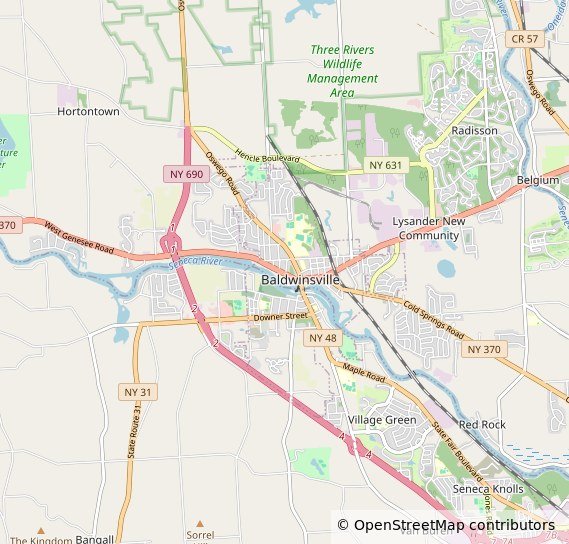
We provide radon testing and mitigation is available throughout Baldwinsville and the surrounding towns of Lysander and Van Buren, including the Radisson community, the village core along the Seneca River and Erie Canal, Plainville, Belgium, and the neighborhoods off Downer Street, Oswego Street, and River Road. We also serve nearby Liverpool, Camillus, and the city of Syracuse.
Frequently Asked Questions
Is radon a concern in Baldwinsville?
Yes — B’ville is in Onondaga County, EPA Zone 1. Both new Radisson-area homes and older village homes can test high.
What does mitigation cost in Baldwinsville?
Cost varies with foundation type and system complexity. We provide a free estimate first.
Do you cover the Radisson community?
Yes, plus the village and surrounding Lysander and Van Buren areas.
Serving Baldwinsville and nearby Liverpool, Cicero, and Camillus.
Helpful reading for Baldwinsville homeowners: radon in new construction homes, radon testing during a home inspection, and selling a home with radon in New York.