
Certified Radon Testing & Mitigation in Liverpool, NY
Licensed, insured, and local. Serving Liverpool and all of Onondaga County — an EPA Radon Zone 1 area.
Radon Mitigation & Testing in Liverpool, NY
Liverpool sits on the northwest shore of Onondaga Lake, and like all of Onondaga County it’s an EPA Radon Zone 1 area — the highest-risk designation for indoor radon. The Liverpool area spans the older village core near the lake, the established Galeville and Bayberry neighborhoods, and the surrounding town of Salina, whose history is literally built on the salt deposits and sedimentary bedrock beneath Central New York — the same geology that lets radon migrate up into homes.
Certified radon testing and mitigation across Liverpool, from mid-century ranches and split-levels in Bayberry to older two-stories near the village and Onondaga Lake Park. Homes here commonly have full basements set into glacial and lake-deposit soils, which provide a direct path for soil gas; certified professionals assess your foundation, sump, and floor-slab conditions and design a system that keeps radon out for good.
Active sub-slab depressurization is the proven fix — a sealed vent pipe and specialized fan that draws radon from beneath the foundation and safely vents it above the roof. Typically a one-day install. Cost depends on the home’s foundation type and system complexity — we’ll give you an exact figure in a free, no-obligation quote.
Why Liverpool Homes Test High for Radon
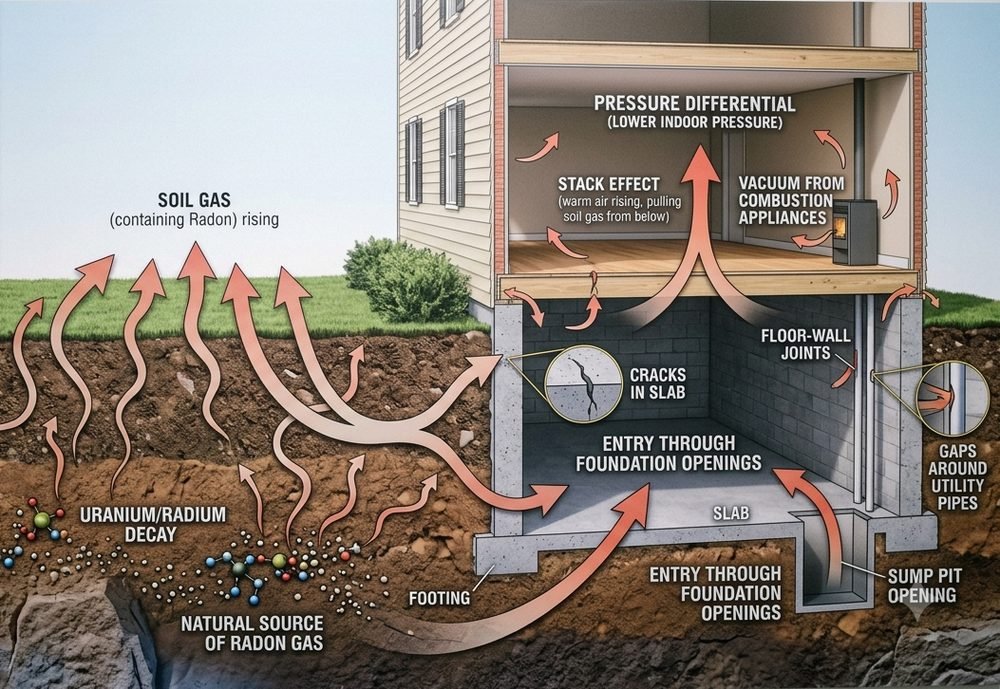
Liverpool sits on the northwest shore of Onondaga Lake, and the ground underneath the village tells the story of why radon is such a persistent problem here. This part of the county sits above the Salina Group — the same salt-bearing shale and gypsum beds that made Syracuse the Salt City. Those formations are interbedded with shale and dolostone that contain trace uranium, and as uranium decays it produces radium, which in turn produces radon gas. The gas migrates upward through fractures in the bedrock and through the loose glacial till that covers it.
What makes Liverpool particularly susceptible is the combination of that geology with the water table near the lake. Seasonal groundwater movement opens and closes pathways in the soil, which is why the same house can produce noticeably different readings in March than it does in August. Homes closer to the lakeshore and in the lower-lying areas along Onondaga Lake Parkway often show more variability between tests than homes farther up the slope toward Bayberry.
How High Do Radon Levels Run Near Liverpool?
The single most useful number for a Liverpool homeowner is the county average. The Onondaga County Health Department reports an average basement radon concentration of 8.1 pCi/L. The EPA recommends corrective action at 4.0 pCi/L, so the typical basement in this county is not marginally elevated but roughly twice the level at which mitigation is advised.
That average is not driven by a handful of extreme outliers. Close to half of all homes screened across the county come back above 4.0 pCi/L, and the county holds the EPA Radon Zone 1 designation. New York State as a whole sits near 18 percent by comparison.
What an average cannot capture is the seasonal movement that matters so much near Onondaga Lake. A Liverpool home can sit below the county average during one part of the year and well above it during another, depending on groundwater conditions at the time of the test. Treat 8.1 as a reason to measure rather than as an estimate of your result.
Liverpool Housing Stock and Radon Entry Points
The village of Liverpool contains a significant amount of pre-1940 housing, including homes built during the salt and willow-weaving era. Older foundations in this area tend to be fieldstone or early poured concrete, both of which develop cracks and gaps over decades of freeze-thaw cycling. Fieldstone foundations in particular are porous by nature and offer radon many entry points rather than one obvious opening.
Outside the village, the Bayberry area and the surrounding stretches of the Town of Salina consist largely of post-war and mid-century construction with poured concrete basements. These homes usually have fewer entry points, but the ones they do have matter: the joint where the basement floor meets the wall, penetrations around plumbing and utility lines, sump pump pits, and floor drains. Homes with a sump pit and no sealed cover are among the most common high-reading properties we see in this part of the county.
Basement use is the other major factor. A Liverpool home with a finished basement family room or a bedroom below grade puts occupants in the highest-concentration part of the house for hours at a time. If your basement is living space rather than storage, testing matters more, not less.
Radon Testing in Liverpool
Testing is straightforward and non-invasive. A short-term test runs from two to seven days under closed-house conditions, meaning windows and exterior doors stay shut except for normal entry and exit. The device is placed in the lowest level of the home that is used or could reasonably be used as living space. For most Liverpool homes, that means the basement.
Short-term testing is the right tool when you need an answer quickly, which is usually the case during a real estate transaction. Long-term testing, running 90 days or more, gives a truer picture of year-round average exposure and is the better choice when you are testing for your own peace of mind rather than a deadline. Given how much seasonal variation shows up near the lake, long-term testing is worth considering for Liverpool homeowners who are not under time pressure.
Placement matters as much as duration. The device should sit at least 20 inches above the floor, away from exterior walls, drafts, and heat sources, and it should stay undisturbed for the full test period. A test interrupted by an open basement window during a warm spell will understate the true level, which is the most common reason a home tests low and then tests high later.
Radon Mitigation in Liverpool
The standard fix is sub-slab depressurization. A pipe is run through the basement floor into the aggregate or soil beneath, connected to a continuously running fan, and vented above the roofline. The fan creates a slight vacuum under the slab so that soil gas is drawn out and released outdoors rather than being pulled into the house.
Older Liverpool homes with fieldstone foundations sometimes need a different approach. Where there is no proper slab to depressurize, or where a portion of the basement has a dirt floor or crawl space, a sealed membrane system may be required instead. These installations take longer and cost more than a standard slab system, which is one reason a site visit and free estimate matter more here than in neighborhoods with uniform construction.
Post-mitigation testing is not optional. After the system runs for at least 24 hours, the home should be retested to confirm the level has actually dropped below 4.0 pCi/L. A system that is installed but never verified is not a completed job.
Selling a Liverpool Home
New York’s Property Condition Disclosure Act requires sellers of residential property to complete a disclosure statement that includes questions about known radon test results and mitigation. If you have tested and know your number, that information belongs on the form. If a mitigation system is installed, it needs to be disclosed as well — and in practice a documented system is usually an asset in the sale rather than a liability, because it removes an unknown from the buyer’s side of the table.
Buyers in the Liverpool market frequently request radon testing during the inspection period. Sellers who test in advance avoid the scramble of negotiating a mitigation credit under deadline pressure.
Areas We Serve Around Liverpool
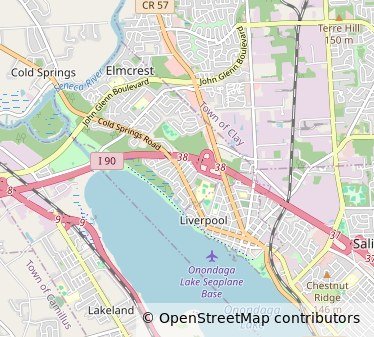
We provide radon testing and mitigation is available throughout the village of Liverpool and the surrounding Town of Salina, including Bayberry, Galeville, Lakeland, and the neighborhoods along Onondaga Lake Parkway, Oswego Street, and Old Liverpool Road. We also serve nearby Baldwinsville, Cicero, and the city of Syracuse.
Frequently Asked Questions
Does Liverpool have a radon problem?
Liverpool is in Onondaga County, EPA Zone 1 — high-risk. Testing is recommended for every home.
How much does mitigation cost in Liverpool?
Cost depends on the home’s foundation and system complexity. Free estimate provided.
Do you test homes near Onondaga Lake?
Yes, throughout the Liverpool, Galeville, and Bayberry areas.
Serving Liverpool and nearby Cicero, Baldwinsville, and Camillus.
Helpful reading for Liverpool homeowners: radon levels by Syracuse zip code, short-term vs. long-term testing, and what to do if your test comes back high.