
Certified Radon Testing & Mitigation in North Syracuse, NY
Licensed, insured, and local. Serving North Syracuse and all of Onondaga County — an EPA Radon Zone 1 area.
Radon Mitigation & Testing in North Syracuse, NY
North Syracuse is a compact, densely settled village just north of the city of Syracuse in Onondaga County, New York — and like the rest of the county, it is an EPA Radon Zone 1 community, where indoor radon is predicted to average above the 4.0 pCi/L action level. Incorporated in 1925 and built out heavily in the decades after World War II, North Syracuse packs roughly 6,700 residents into about two square miles around the Route 11 and Interstate 81 corridors near Hancock Airport. That dense stock of mid-century homes — most on basements or slabs of the same era — is exactly the kind of housing where radon commonly collects, regardless of a home’s age or condition.
Certified radon testing and mitigation is available throughout North Syracuse, including the village center around Church and Main, the neighborhoods along Route 11, and the surrounding areas of Mattydale and the town of Clay. Homes here span dense postwar construction on glacial till and a scattering of older village properties, so systems are matched to each foundation. Certified professionals evaluate your specific home and design the right system for it.
Why North Syracuse Homes Test High for Radon
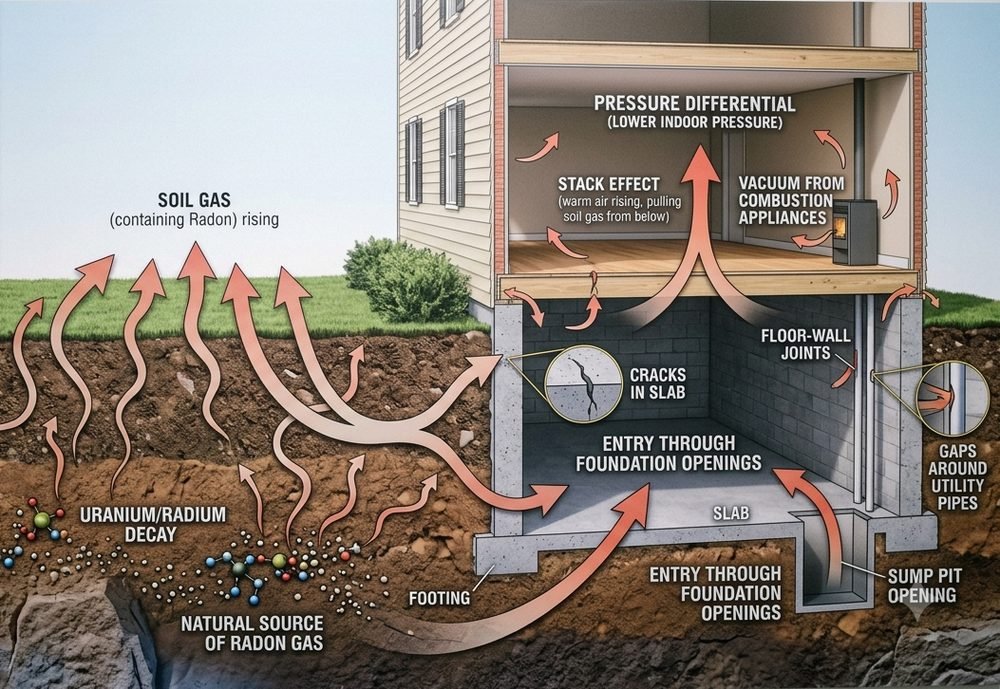
North Syracuse sits on the gently rising ground north of the city, above the low lake plain, on a base of dense glacial till left by the last ice sheet. Beneath that till is the same trace-uranium-bearing sedimentary bedrock that underlies all of Onondaga County. Radon forms as that uranium and radium decay, and the gas works its way up through cracks in the till and bedrock toward the foundations built on top — which is why an entire EPA Zone 1 county, North Syracuse included, is expected to average above the 4.0 pCi/L action level.
What makes North Syracuse distinctive is not unusual geology but unusually dense, uniform housing. Because so many homes were built close together in the same postwar decades, on similar foundations over the same till, neighboring houses often test in a similar range — a high reading two doors down is a genuine reason to test your own. Compact village lots also mean less soil buffer around each foundation, so soil gas has a short path to the nearest slab or basement wall.
Radon does not respect a home’s tidy appearance or recent updates. A well-kept North Syracuse ranch and a worn one on the same street can test very differently, and the only way to know a specific home’s level is to measure it.
North Syracuse Sits in an EPA Radon Zone 1 County
Every part of Onondaga County, North Syracuse included, carries the EPA Radon Zone 1 designation. That is the highest of the agency three risk categories, applied to counties where the predicted average indoor screening level exceeds the 4.0 pCi/L action level. It is a statement about the county as a whole rather than a prediction for any single address.
The measured figures behind that designation come from the Onondaga County Health Department, which reports an average basement level of 8.1 pCi/L, and from testing showing that close to half of homes screened countywide exceed 4.0 pCi/L. The New York State Department of Health puts the statewide figure near 18 percent, so Onondaga County runs at roughly three times the state rate.
None of these numbers describe a specific North Syracuse property. Because homes here sit so close together on similar postwar foundations, a neighbor’s result is a useful prompt, but it is no substitute for testing your own home — the only way to know a particular house’s level.
North Syracuse Housing Stock and Radon Entry Points
North Syracuse housing is dominated by the postwar building boom. Cape Cods, ranches, and split-levels from the 1940s through the 1960s make up the bulk of the village, most built on full basements or concrete slabs. Slab-on-grade homes of this era are a classic radon pathway: a single crack or the perimeter gap where slab meets wall is often all the soil gas needs, and mitigation usually means a sub-slab depressurization system tied into that slab.
Basement homes from the same decades bring their own entry points — block foundations, floor-wall joints, and older sump pits that were never sealed. Because these houses sit on small village lots close to their neighbors, a mitigation system has to be designed to draw effectively under a compact footprint, and radon fan placement matters for keeping noise down between closely spaced homes.
Scattered among the postwar stock are older homes near the original village center at Church and Main, some predating incorporation in 1925. These may have stone or early block foundations, partial basements, and crawl spaces that need a tailored, multi-point approach rather than a single standard system.
Radon Mitigation Contractors in North Syracuse
Certified radon professionals design and install each system for the specific North Syracuse home — a sub-slab system tied into a postwar slab, or a sealed, multi-point approach for an older village home near Church and Main. Radon mitigation in North Syracuse is also known as radon abatement, radon removal, or radon remediation. We offer a free estimate on every North Syracuse project.
The standard, most effective fix is active sub-slab depressurization — a sealed vent and in-line fan that pulls radon from beneath the slab and exhausts it above the roofline. Most systems install in a day. Cost depends on the home’s foundation type and system complexity — we’ll give you an exact figure in a free, no-obligation quote. depending on foundation and complexity.
Newer North Syracuse homes are usually straightforward to mitigate. A sound poured slab over permeable fill is close to the ideal case for sub-slab depressurization, and one properly placed suction point commonly serves the whole footprint.
The dense village setting introduces a design consideration that matters more here than in the open suburbs. On small lots with homes close together, fan and exhaust placement has to be planned so a system runs quietly and vents cleanly without crowding a neighbor, and slab-on-grade homes need careful suction-point placement to pull evenly under the whole floor.
Older farmhouses with partial basements or crawl space sections often need a sealed membrane across exposed soil, tied into the same fan and vent stack serving the slab portion. Mixed foundations of this kind are common on North Syracuse rural properties and are the main reason estimates vary here.
Radon Testing in North Syracuse
We use continuous radon monitors for fast, accurate, tamper-resistant results in about 48 hours — important for both peace of mind and real-estate timelines, since New York addresses radon on its Property Condition Disclosure Statement. In North Syracuse’s dense postwar housing, where homes are closed up tight through the long heating season, winter testing reflects real living conditions well.
Radon levels naturally rise in winter, when homes are closed up and the stack effect pulls soil gas indoors, so a test run in the heating season reflects the conditions your family actually lives in. Where a decision is not tied to a closing deadline, a longer-term test gives the most trustworthy picture of a North Syracuse home’s year-round average.
For rural properties on private wells, water testing is a separate procedure from air testing and requires a sample sent to a laboratory. If your North Syracuse home draws from a drilled well and the air test comes back elevated, the water is worth checking as a possible contributing source rather than assuming the soil accounts for all of it.
Selling a North Syracuse Home
North Syracuse’s affordable, well-located housing makes it a busy market for first-time buyers and investors, which means a high share of homes here sell with a home inspection attached — and radon testing is a routine part of many of those inspections. Under the New York Property Condition Disclosure Act, sellers must report any known radon results and mitigation work on the disclosure statement.
For a North Syracuse seller, the practical move is to test before listing rather than react to a buyer’s inspection. A pre-listing test turns radon from a last-minute negotiating surprise into a known quantity: if a system is needed, it can be installed and documented ahead of time, which reassures the value-conscious buyers who drive this market and keeps the sale on schedule.
Areas We Serve Around North Syracuse
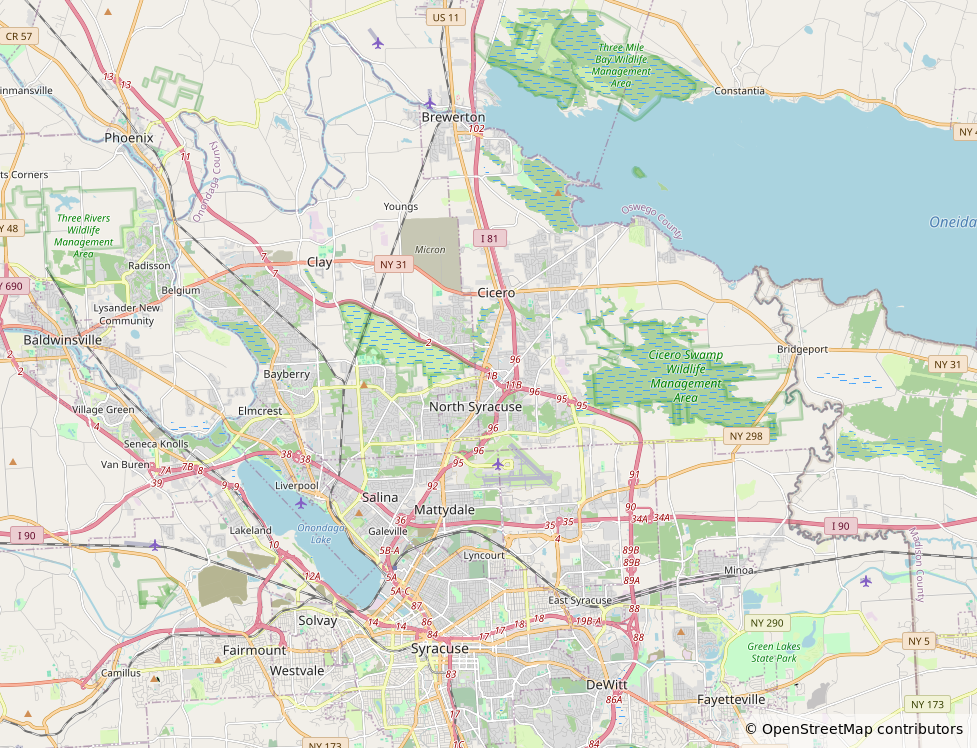
Radon testing and mitigation is available throughout North Syracuse and the immediately surrounding communities, including Mattydale, Galeville, and the neighborhoods along Route 11 and Taft Road bordering the town of Clay and Cicero. We also serve nearby Liverpool, DeWitt, and the city of Syracuse.
Buying or selling in North Syracuse? See our radon testing for home sales. We also use continuous radon monitors for fast, accurate results, and install radon systems in new construction.
Frequently Asked Questions
Is radon common in North Syracuse, NY?
Yes. North Syracuse sits in EPA Radon Zone 1 on dense glacial till, and its tightly packed postwar homes commonly test at elevated levels. Testing is the only way to know your home reading.
How much is radon mitigation in North Syracuse?
Cost varies with foundation type and system complexity depending on your home. We estimate before any work.
Can you test newer North Syracuse homes?
Yes — new construction can have elevated radon too. We test homes of every age.
Serving North Syracuse and nearby Liverpool, Baldwinsville, and the northern Onondaga County towns.
Helpful reading for North Syracuse homeowners: DIY kits vs. professional testing, what to do if your radon test comes back high, and what a mitigation system looks like.