
New Construction Radon Systems in Syracuse, NY
Permanent radon reduction systems, installed by certified pros. Licensed, insured, and local to Onondaga County.
New Construction Radon Systems in Syracuse, NY
If your Syracuse-area home has tested at or above the EPA action level of 4.0 pCi/L, a radon mitigation system — also called radon removal, radon abatement, or radon remediation — is the permanent solution. Onondaga County is an EPA Radon Zone 1 area — the highest-risk designation — so elevated radon is common here, and a properly designed mitigation system is the proven way to bring your home’s levels down and keep them there. Certified professionals who design, install, and verify systems across Syracuse and the surrounding towns.
Radon-Resistant New Construction and Building Standards
Building radon protection into a new home follows a well-established set of radon-resistant new construction (RRNC) techniques. These methods — a gas-permeable layer beneath the slab, a sealed vapor barrier, a capped vent pipe run from below the foundation up through the roof, and sealed slab penetrations — are the same fundamentals recommended by the EPA for new builds in high-radon areas like Onondaga County. Following them during construction is far simpler and cheaper than retrofitting later.
For builders working across the Syracuse area, incorporating these techniques signals quality and protects buyers from day one. For a homeowner commissioning a custom build, asking your builder to follow radon-resistant construction standards — and confirming a passive vent stack is roughed in — is a small request that pays off in a safer, more marketable home.
Why New Homes Still Need Radon Protection
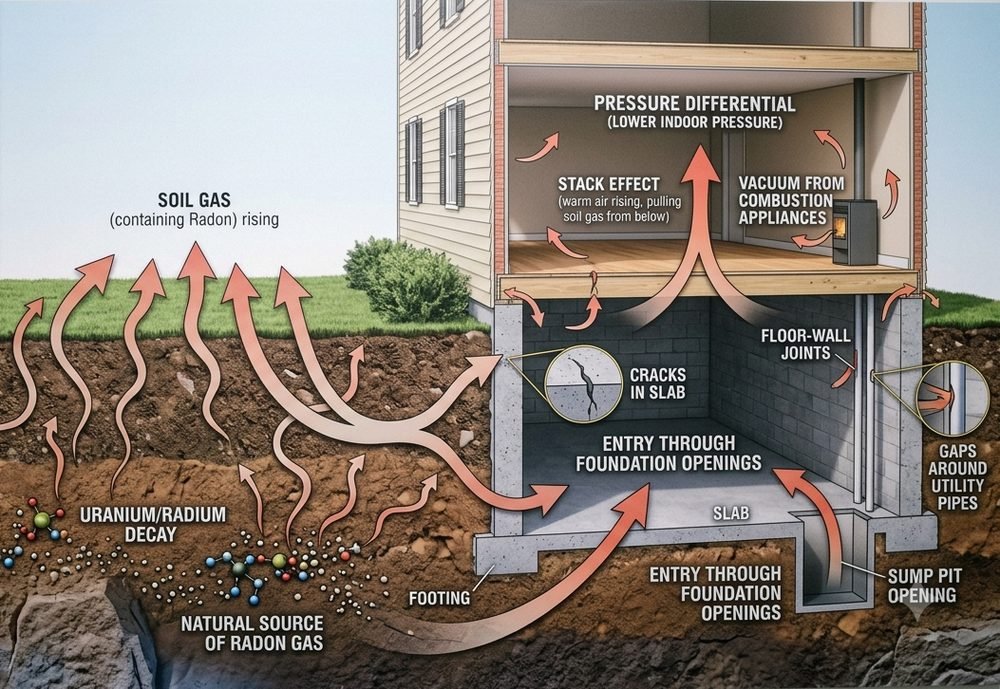
Radon comes from the natural decay of uranium in the soil beneath a home, so it depends on the ground a house sits on, not the age of the structure. A newly poured slab over Zone 1 soil can concentrate radon just as readily as a decades-old basement — sometimes more so, because modern homes are built tight and well-sealed, which can trap soil gas indoors. Every new home in the region should be tested once it is occupied, regardless of how it was built.
Buyers of new construction often assume a new build is automatically safe. Testing is the only way to know, and building in protection during construction makes any later fix simpler and cheaper.
Passive Radon Systems and Radon-Ready Construction
The most cost-effective time to install radon protection is during the build. A passive radon system — sometimes called a radon-ready or radon-resistant rough-in — places a gas-permeable layer and a vent pipe beneath the slab that runs up through the home and out the roof, using natural stack effect to draw soil gas away without a fan. It adds relatively little to the cost of a new build and is far cheaper to install during construction than to retrofit later.
If a post-occupancy test shows the passive system is not bringing levels below 4.0 pCi/L on its own, activating it is simple: an inline radon fan is added to the existing vent pipe, converting the passive rough-in into a full active system with minimal work. Building the rough-in first makes that upgrade fast and inexpensive.
Testing a Newly Built Home for Radon
Whether or not a passive system was installed, a new home should be tested once it is occupied and living under normal closed-house conditions. A short-term test with a continuous radon monitor gives a fast, accurate reading, and for a home with a passive system it confirms whether the passive rough-in is doing the job or whether a fan should be added. For new construction being bought and sold, that test also gives the buyer documented peace of mind.
Builders and buyers in active Syracuse-area developments increasingly treat radon testing as a standard part of closing out a new home, the same way a final walkthrough or systems check would be.
Working With Builders and New-Home Buyers on Radon
For builders, offering radon-ready construction is a genuine selling point in a Zone 1 market, and coordinating the passive rough-in during the foundation stage is straightforward with a certified radon professional involved early. For buyers of a newly built home, requesting a radon test — and asking whether a passive system was included — is a smart, low-cost step that protects your family from the start.
From passive rough-ins during construction to post-occupancy testing and fan activation when needed, certified professionals help builders and homeowners make new Syracuse-area homes radon-safe the right way.
Related: Explore our full radon mitigation and system installation services, and see why every new home should still get radon testing.
New to radon in new construction? See our answers to common radon questions for straight talk on testing, systems, and cost.
Certified, Licensed & Insured Professionals
Radon mitigation in New York should be performed by professionals certified through the National Radon Proficiency Program (NRPP) or the National Radon Safety Board (NRSB) — the two EPA-recognized certification bodies. New York’s Department of Health maintains a list of certified radon mitigation contractors. Always confirm your provider is certified, licensed, and insured before work begins.
Searching for radon mitigation in your area? We serve homeowners across the Syracuse metro and Onondaga County.
Frequently Asked Questions
Do new construction homes need radon testing?
Yes. Radon depends on the soil a home sits on, not its age, and all of Onondaga County is a high-radon zone. Every new home should be tested once occupied, even if a passive system was installed.
What is a passive radon system?
A passive, or radon-ready, system is a vent pipe and gas-permeable layer built under the slab during construction that uses natural stack effect — no fan — to draw soil gas away. It is inexpensive to install during a build.
What if a passive system does not lower radon enough?
If a post-occupancy test still shows elevated levels, activating the system is simple: an inline fan is added to the existing vent pipe, converting it to a full active system with minimal work.
Serving Syracuse and the surrounding Onondaga County communities including Cicero, Liverpool, Baldwinsville, Camillus, Manlius, DeWitt, Lysander, North Syracuse, East Syracuse, Skaneateles, and Fayetteville.
Where We Install: We install radon systems in new construction across Onondaga County, including Syracuse, Cicero, Liverpool, Baldwinsville, Camillus, Manlius, DeWitt, Lysander, North Syracuse, East Syracuse, Skaneateles, and Fayetteville.