
Radon Testing for Rental Property in Syracuse, NY
Fast, certified radon testing you can trust — protecting your tenants and your rental property investment. Licensed & insured.
Radon Testing for Rental Property in Syracuse, NY
The only way to know your home’s radon level is to test. Because Onondaga County is an EPA Radon Zone 1 area — the highest-risk designation — every home in the Syracuse region should be tested, regardless of age, foundation type, or whether a neighbor’s home tested low. Radon is invisible, odorless, and varies house to house. Certified professionals who provide fast, accurate radon testing across Syracuse and the surrounding towns.
Why Landlords Should Test Rental Properties for Radon
Tenants spend as much time in a home as any owner, and ground-floor and basement units are where radon tends to concentrate. In a county where roughly half of tested homes exceed the 4.0 pCi/L action level, assuming a rental is fine without testing is a real gamble. A documented radon test shows a landlord took reasonable steps to provide a safe dwelling, and if a level comes back high, mitigation is a modest, one-time investment that protects tenants for years.
Testing also protects the property owner. A tenant who later learns a unit had an untested or ignored radon problem has grounds for a serious dispute. Getting ahead of the issue with certified testing — and mitigation where needed — is far less costly than dealing with it after the fact.
Radon Testing for Multi-Unit and Multi-Family Buildings
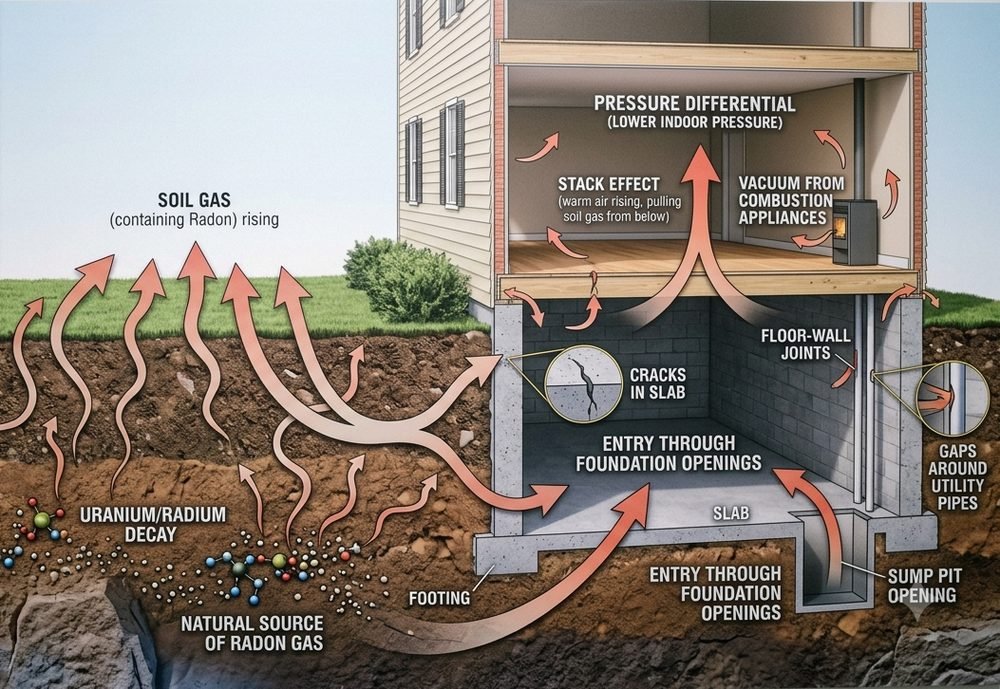
Radon does not distribute evenly across a building. In a duplex or multi-family property, each ground-contact unit can have a different level depending on its foundation, layout, and how much time it spends closed up. For that reason, testing should cover every ground-floor and below-grade unit rather than assuming one reading represents the whole building. Upper-floor units with no ground contact are generally lower risk.
For larger buildings, a certified technician can plan a testing layout that samples the units most likely to be affected, giving a clear, documented picture of the whole property. Continuous radon monitors keep the process fast and the results defensible.
When to Test a Rental for Radon: Between Tenancies and Beyond
The most practical time to test a rental is between tenancies, when a unit is vacant and closed-house conditions are easy to maintain for the 48-hour minimum test period. A turnover window also makes it simple to mitigate before a new tenant moves in, if a level comes back elevated. Beyond turnovers, it is worth testing after any major foundation work, after significant changes to heating or ventilation, and periodically as a matter of good practice.
For an occupied unit, testing can still be done with the tenant’s cooperation in keeping windows and doors closed during the test. Scheduling around a vacancy simply makes everything easier for landlord and tenant alike.
If a Rental Tests High for Radon: Mitigation for Landlords
An elevated result is a solvable problem. A sub-slab depressurization system installed by a certified professional reliably brings levels down and typically goes in within a day, with a follow-up test to confirm the fix. For a landlord, that one-time cost delivers lasting protection for every future tenant of the unit and documentation that the property was made safe.
Handling radon proactively is part of responsible property management in Central New York. Certified testing gives you the facts, and mitigation — where it is needed — turns a hidden risk into a documented, resolved line item.
Related: See our general radon testing and radon mitigation services, or learn about radon testing for a home sale if you are buying or selling an investment property.
Not sure what testing a rental involves? Our common radon questions page covers the basics in plain language.
Certified, Licensed & Insured Professionals
Radon testing in New York should be performed by professionals certified through the National Radon Proficiency Program (NRPP) or the National Radon Safety Board (NRSB) — the two EPA-recognized certification bodies. Always confirm your provider is certified before testing, so your results are accurate and accepted in a real-estate transaction.
Looking for radon testing in your area? We serve homeowners throughout the Syracuse metro and Onondaga County.
Frequently Asked Questions
Are landlords required to test rental properties for radon in New York?
New York does not currently mandate radon testing in rentals, but landlords have a general duty to provide a safe dwelling. Given that all of Onondaga County is a high-radon zone, testing is strongly recommended to protect tenants and limit liability.
Do I need to test every unit in a multi-family building?
Every ground-floor and below-grade unit should be tested, since radon levels vary by foundation and layout. Upper-floor units with no ground contact are generally lower risk.
When is the best time to test a rental unit?
Between tenancies is ideal, since a vacant unit makes closed-house conditions easy to maintain and allows time to mitigate before a new tenant moves in if needed.
Serving Syracuse and the surrounding Onondaga County communities including Cicero, Liverpool, Baldwinsville, Camillus, Manlius, DeWitt, Lysander, North Syracuse, East Syracuse, Skaneateles, and Fayetteville.
Where We Test: We provide radon testing for rental properties across Onondaga County, including Syracuse, Cicero, Liverpool, Baldwinsville, Camillus, Manlius, DeWitt, Lysander, North Syracuse, East Syracuse, Skaneateles, and Fayetteville.