
Certified Radon Testing & Mitigation in Fayetteville, NY
Licensed, insured, and local. Serving Fayetteville and all of Onondaga County — an EPA Radon Zone 1 area.
Radon Mitigation & Testing in Fayetteville, NY
Fayetteville is an affluent historic village about eight miles east of Syracuse, in the town of Manlius, Onondaga County, New York — and like the rest of the county, it is an EPA Radon Zone 1 community, where indoor radon is predicted to average above the 4.0 pCi/L action level. Incorporated in 1844 and home to some of the highest household incomes in the county, Fayetteville centers on the Genesee Street Hill historic district, where Greek Revival and Italianate homes built on limestone-quarry prosperity still stand alongside newer suburban neighborhoods. That mix of century-old and modern housing, set on limestone bedrock, makes radon testing worthwhile across the village regardless of a home’s age or value.
Certified radon testing and mitigation is available throughout Fayetteville, including the Genesee Street Hill historic district, the neighborhoods around Limestone Creek, and the newer subdivisions toward Green Lakes. Historic homes and modern suburban houses each get a system matched to their foundation. Certified professionals evaluate your specific home and design the right approach for it.
Why Fayetteville Homes Test High for Radon
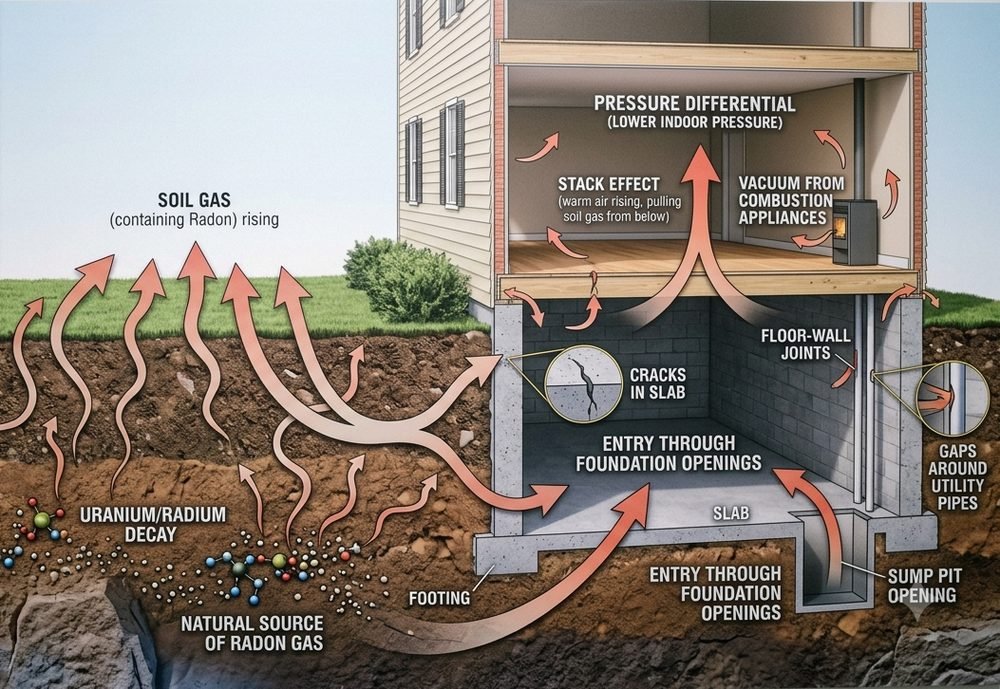
Fayetteville sits on the limestone country of eastern Onondaga County, in the belt of carbonate and shale bedrock that gave the village its quarries, its Limestone Creek, and the striking meromictic lakes at nearby Green Lakes State Park. That bedrock carries trace uranium, and as it decays it produces radon gas that rises toward the surface. Limestone is prone to fractures, joints, and solution channels, and those openings give radon an efficient path up through the soil and into the foundations built above — which is why the whole area falls in EPA Radon Zone 1, predicted to average above the 4.0 pCi/L action level.
The gently rolling hills around Genesee Street add to this. Homes built into the slopes above Limestone Creek often have foundations set close to fractured rock, and basements cut into hillsides give soil gas more foundation surface to enter through. The result is that radon here is driven by a genuine bedrock source, not just surface soil, so levels can be meaningful even in well-built homes.
None of this shows on the surface. A grand historic home on Genesee Street and a newer house in a Fayetteville subdivision can test very differently, and price or upkeep says nothing about radon. Only a test reveals what a specific Fayetteville home is doing.
Fayetteville Sits in an EPA Radon Zone 1 County
Every part of Onondaga County, Fayetteville included, carries the EPA Radon Zone 1 designation. That is the highest of the agency three risk categories, applied to counties where the predicted average indoor screening level exceeds the 4.0 pCi/L action level. It is a statement about the county as a whole rather than a prediction for any single address.
The measured figures behind that designation come from the Onondaga County Health Department, which reports an average basement level of 8.1 pCi/L, and from testing showing that close to half of homes screened countywide exceed 4.0 pCi/L. The New York State Department of Health puts the statewide figure near 18 percent, so Onondaga County runs at roughly three times the state rate.
None of these numbers describe a specific Fayetteville property. With uranium-bearing limestone beneath the village and fractured rock under many hillside homes, readings differ from one property to the next — only testing your own home reveals its actual level.
Fayetteville Housing Stock and Radon Entry Points
Fayetteville’s housing runs from grand and historic to comfortably modern. The Genesee Street Hill historic district holds a remarkable collection of Federal, Greek Revival, Gothic Revival, and Italianate homes from the 1800s, many built during the village’s canal-and-quarry prosperity. These older houses typically have stone or early masonry foundations, deep cellars, and additions layered over generations — and those cellars, with unsealed floors and cracked stone walls, are common radon entry points that often need sealing alongside a sub-slab or sub-membrane system.
Surrounding the historic core are the mid-century and later suburban neighborhoods that made Fayetteville a favored commuter address for Syracuse professionals. Ranches, colonials, and split-levels on poured or block basements fill the former orchards and farm fields around the village. These homes usually take a standard sub-slab depressurization system, though a home’s position on the rolling terrain influences where suction points work best.
Newer and upscale construction continues on the edges of the village and toward Green Lakes, generally on modern foundations that are straightforward to mitigate. Across every era, the shared limestone bedrock beneath the village means an elevated reading in one home is a fair reason for others nearby to test.
Radon Mitigation Contractors in Fayetteville
Certified radon professionals design and install each system for the specific Fayetteville home — sealing and sub-slab work for a historic Genesee Street cellar, or a straightforward system for a modern home near Green Lakes. Radon mitigation in Fayetteville is also known as radon abatement, radon removal, or radon remediation. We offer a free estimate on every Fayetteville project.
The standard, most effective fix is active sub-slab depressurization — a sealed vent and in-line fan that pulls radon from beneath the slab and exhausts it above the roofline. Most systems install in a day. Cost depends on the home’s foundation type and system complexity — we’ll give you an exact figure in a free, no-obligation quote. depending on foundation and complexity.
Newer Fayetteville homes are usually straightforward to mitigate. A sound poured slab over permeable fill is close to the ideal case for sub-slab depressurization, and one properly placed suction point commonly serves the whole footprint.
The limestone geology introduces a design consideration that flatter parts of the county do not share. Where a foundation sits near fractured bedrock or is cut into a slope above Limestone Creek, soil gas can travel through rock joints and solution channels, so a system’s suction points must be placed to draw across the whole foundation rather than assume an even bed of soil beneath the slab.
Older farmhouses with partial basements or crawl space sections often need a sealed membrane across exposed soil, tied into the same fan and vent stack serving the slab portion. Mixed foundations of this kind are common on Fayetteville rural properties and are the main reason estimates vary here.
Radon Testing in Fayetteville
We use continuous radon monitors for fast, accurate, tamper-resistant results in about 48 hours — important for both peace of mind and real-estate timelines, since New York addresses radon on its Property Condition Disclosure Statement. In Fayetteville’s competitive, high-value market, a documented pre-listing radon result reassures buyers and keeps sales on schedule.
Radon levels usually peak in winter, when a closed-up home draws soil gas indoors through the stack effect, so a heating-season test reflects how the house is actually lived in. Where a decision is not tied to a closing deadline, a longer-term test gives the most reliable read on a Fayetteville home’s year-round average.
For rural properties on private wells, water testing is a separate procedure from air testing and requires a sample sent to a laboratory. If your Fayetteville home draws from a drilled well and the air test comes back elevated, the water is worth checking as a possible contributing source rather than assuming the soil accounts for all of it.
Selling a Fayetteville Home
Fayetteville consistently posts some of the highest property values in Onondaga County, driven by its historic charm and the strong Fayetteville-Manlius school district. High-value homes in a competitive market almost always sell with a thorough professional inspection, and radon testing is a routine part of it. Under the New York Property Condition Disclosure Act, sellers must report any known radon results and mitigation work on the disclosure statement.
For a Fayetteville seller, particularly of an older Genesee Street-area home, testing before listing is the wise move. Historic houses on limestone are more likely to return an elevated reading, and a surprise during a buyer’s inspection can jeopardize a high-value sale. A pre-listing test lets a seller install and document any needed system on their own schedule, keeping a significant transaction on track and protecting the home’s value.
Areas We Serve Around Fayetteville
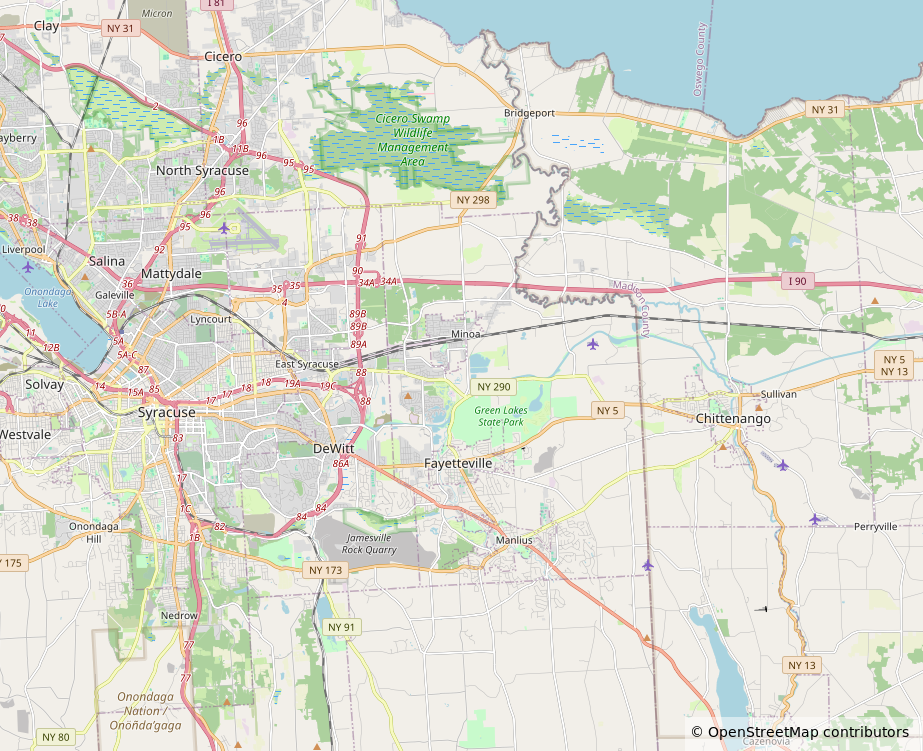
Radon testing and mitigation is available throughout Fayetteville and the surrounding town of Manlius, including the areas near Green Lakes State Park, Manlius village, and the Route 5 and Route 257 corridors. We also serve nearby Manlius, DeWitt, and the city of Syracuse.
Buying or selling in Fayetteville? See our radon testing for home sales. We also use continuous radon monitors for fast, accurate results, and install radon systems in new construction.
Frequently Asked Questions
Is radon common in Fayetteville, NY?
Yes. Fayetteville sits in EPA Radon Zone 1 over uranium-bearing limestone bedrock, and its historic and hillside homes commonly test at elevated levels. Testing is the only way to know.
How much is radon mitigation in Fayetteville?
It depends on the home — a historic Fayetteville house with stone cellars may need sealing plus a sub-slab system, while a modern home often takes a single setup. We assess the property and give a free estimate first.
Can you test newer Fayetteville homes?
Yes — new construction can have elevated radon too. We test homes of every age.
Serving Fayetteville and nearby Manlius, DeWitt, and the eastern Onondaga County suburbs.
Helpful reading for Fayetteville homeowners: radon when selling a home in New York, radon and finished basements, and what affects radon mitigation cost.