
Certified Radon Testing & Mitigation in DeWitt, NY
Licensed, insured, and local. Serving DeWitt and all of Onondaga County — an EPA Radon Zone 1 area.
Radon Mitigation & Testing in DeWitt, NY
DeWitt sits on the east side of Syracuse, and like all of Onondaga County it’s an EPA Radon Zone 1 community — the highest-risk category for indoor radon. DeWitt spans well-established neighborhoods that developed as Syracuse’s eastern suburbs matured, and it borders Jamesville, an area defined by its limestone quarry and the sedimentary bedrock underlying the whole eastern county. That limestone-and-quarry geology is exactly the kind of substrate through which radon migrates into home foundations — making testing especially worthwhile here.
Certified radon testing and mitigation is available throughout DeWitt, including the older neighborhoods off Erie Boulevard and Genesee Street, the areas near Jamesville, and the surrounding developments. DeWitt’s established housing stock brings full basements and, in older homes, fieldstone foundations, cracks, and sumps — multiple radon entry points that a properly designed system seals off. Certified professionals evaluate your foundation’s specific conditions before recommending a system.
Why DeWitt Homes Test High for Radon
DeWitt sits at the contact between two very different geologies, and homes on opposite sides of the town can sit above quite different ground. The southern and eastern portions rise toward the Onondaga escarpment, where Devonian limestone comes near the surface. The northern and western portions slope down toward the Erie Canal corridor and the old lake plain, where thicker glacial and lacustrine deposits cover the bedrock.
The Jamesville area is the clearest illustration. Limestone has been quarried there on an industrial scale for well over a century, which means the rock is not merely present but has been extensively fractured, blasted, and dewatered across a wide area. Quarrying alters the local subsurface in ways that persist: it opens new fracture networks, changes how groundwater drains, and leaves disturbed ground and fill in places where undisturbed rock once sat.
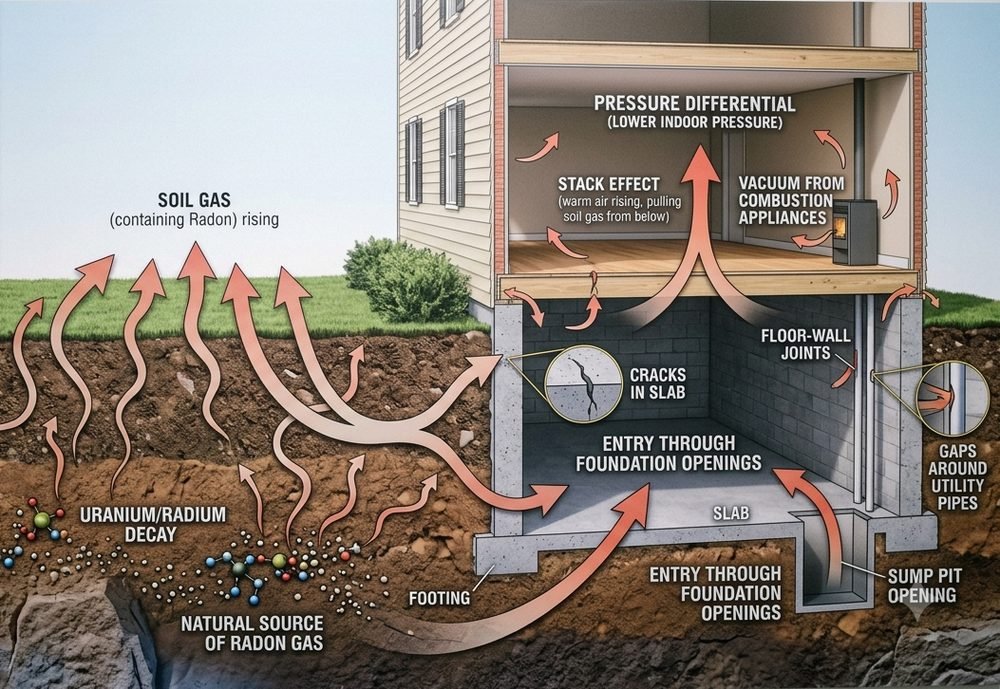
Those changes matter for radon because soil gas travels along whatever pathways exist. Fractured and blast-disturbed rock offers more of them than intact rock does, and altered drainage changes which pathways stay open through the year. Homes in the Jamesville corridor and along the escarpment edge frequently produce higher and less predictable readings than their neighbors a mile downslope, where deeper unconsolidated cover moderates gas movement.
What Testing Across Onondaga County Has Found
Testing across Onondaga County has consistently found that close to half of screened homes exceed the EPA action level of 4.0 pCi/L, with the Onondaga County Health Department reporting an average basement concentration of 8.1 pCi/L. Set against the New York State Department of Health statewide estimate of roughly 18 percent above 4.0 pCi/L, the county runs at approximately three times the state rate, and holds the EPA Radon Zone 1 classification.
What those aggregate findings cannot capture is variation within a single town, and DeWitt is a good example of why that limitation matters. A page of county statistics tells a Jamesville homeowner and a Lyndon homeowner exactly the same thing, even though the ground beneath them differs substantially.
Treat the county figures as establishing that testing is warranted, not as an estimate of your result. The measurement that matters is the one taken in your own basement.
DeWitt Housing Stock and Radon Entry Points
DeWitt is largely a postwar suburb, and its housing reflects the decades when Syracuse expanded eastward. Ranches, colonials, and split-levels from the 1950s through the 1970s dominate neighborhoods like Lyndon, Springfield Gardens, and the areas off Erie Boulevard East, most of them on full poured concrete basements.
Foundations of that era occupy an awkward middle ground for radon. They are sound enough that homeowners rarely think about them, but they have now been through six or seven decades of freeze-thaw cycling, settlement, and slab curing. The perimeter joint where the floor meets the wall has usually opened slightly. Control joints have widened. Original sump pits are often uncovered or fitted with loose lids that seal nothing.
Jamesville and the southern reaches of the town include older properties, some with stone foundations and partial basements, along with newer homes built on the higher ground near the escarpment. Foundation type varies more here than in the postwar tracts to the north.
DeWitt also has a substantial commercial and institutional presence along Erie Boulevard and around the office parks, and radon is not solely a residential concern. Slab-on-grade commercial buildings with occupied lower levels are subject to the same soil gas entry as houses, and are tested far less often.
Radon Mitigation in DeWitt
The standard, effective fix is active sub-slab depressurization — a sealed vent and in-line fan that draws radon from beneath the foundation and exhausts it above the roofline. Most systems install in a single day. Cost depends on the home’s foundation type and system complexity — we’ll give you an exact figure in a free, no-obligation quote. depending on foundation and complexity.
Postwar DeWitt basements are generally well suited to sub-slab depressurization. The slabs are sound, the aggregate beneath is usually adequate, and one properly placed and sized suction point commonly brings the entire footprint below the action level.
The work that most often gets skipped on homes of this age is sealing. Six decades of movement leave a perimeter joint, control joints, and slab penetrations that all leak. Sealing them does not by itself solve a radon problem, and should never be sold as a standalone fix, but it substantially improves how well the depressurization system performs by letting the fan pull from beneath the slab rather than from basement air.
Properties nearer Jamesville and the escarpment can be less predictable. Where bedrock sits close beneath the slab with limited permeable material in between, achieving good pressure field extension takes more care, and a second suction point is sometimes necessary. This is worth diagnosing before installation rather than discovering at the retest.
Radon Testing in DeWitt
Continuous radon monitors deliver fast, certified, tamper-resistant results in about 48 hours — important for peace of mind and for New York real-estate transactions, where radon is a disclosure item.
Because conditions vary so much between the escarpment side of DeWitt and the lower ground toward the canal, a neighbor result is a poor guide here. It is common for two homes a short distance apart to return meaningfully different numbers, and homeowners who skip testing because a friend nearby tested low are relying on the least reliable evidence available.
For the postwar housing that makes up most of the town, the standard approach applies without complication: a short-term test of two to seven days under closed-house conditions, placed in the lowest level that is used or could be used as living space, at least 20 inches above the floor and away from exterior walls and drafts.
Selling a DeWitt Home
DeWitt turns over steadily, and radon testing during the inspection period is routine in this market rather than exceptional. New York Property Condition Disclosure Act requires sellers to report known radon results and any mitigation on the disclosure statement.
A documented system is generally an asset in a DeWitt sale. Buyers here tend to be familiar with radon as a regional issue, and a resolved, documented condition is easier to price than an open question discovered eight days before closing.
Areas We Serve Around DeWitt
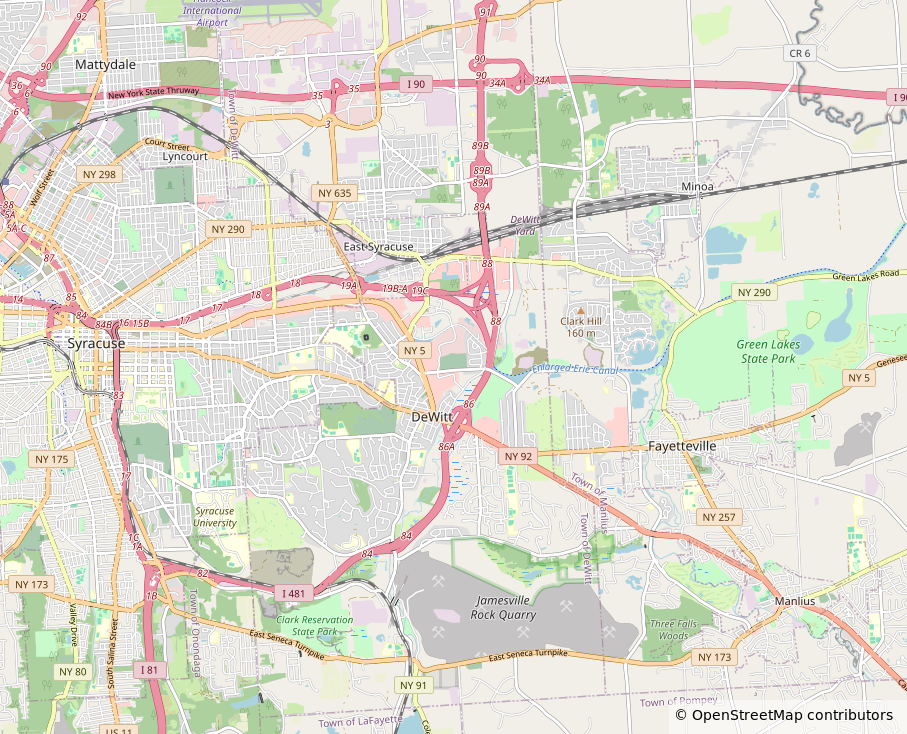
We provide radon testing and mitigation is available throughout the Town of DeWitt, including Jamesville, Lyndon, Springfield Gardens, Collamer, and the neighborhoods along Erie Boulevard East, East Genesee Street, and Jamesville Road. We also serve neighboring Manlius, Cicero, and the city of Syracuse.
Frequently Asked Questions
Is radon common in DeWitt, NY?
DeWitt is in Onondaga County, EPA Zone 1 — high-risk. The nearby Jamesville limestone geology makes testing especially worthwhile.
How much is radon mitigation in DeWitt?
Cost varies with foundation type and system complexity. Free estimate provided first.
Do you test older east-side homes?
Yes — older homes often have multiple radon entry points, which we seal and mitigate.
Serving DeWitt and nearby Manlius, Syracuse, and Camillus.
Helpful reading for DeWitt homeowners: what a mitigation system looks like, radon testing during a home inspection, and selling a home with radon in New York.