
Radon Mitigation System Installation in Syracuse, NY
Permanent radon reduction systems, installed by certified pros. Licensed, insured, and local to Onondaga County.
Radon Mitigation System Installation in Syracuse, NY
If your Syracuse-area home has tested at or above the EPA action level of 4.0 pCi/L, a radon mitigation system — also called radon removal, radon abatement, or radon remediation — is the permanent solution. Onondaga County is an EPA Radon Zone 1 area — the highest-risk designation — so elevated radon is common here, and a properly designed mitigation system is the proven way to bring your home’s levels down and keep them there. Certified professionals who design, install, and verify systems across Syracuse and the surrounding towns.
How Long a Radon Mitigation System Lasts
A properly installed radon mitigation system is built to run continuously for years. The inline radon fan — the only moving part — typically lasts a decade or more before it needs replacement, and swapping a fan is a quick, inexpensive service rather than a full reinstall. The PVC piping and sealed suction points are permanent, so once a system is in, the home stays protected with only occasional attention.
What It Costs to Run a Radon System
Running costs are modest: the radon fan draws about as much electricity as a standard light bulb and adds only a small amount to a monthly utility bill. Ongoing upkeep is minimal, too. The system monitor — usually a simple manometer on the vent pipe — lets a homeowner confirm at a glance that the fan is pulling properly. If the manometer ever reads level, that is the signal the fan may need service. Re-testing radon every couple of years, and after any major home renovation, confirms the installed system is still keeping levels safely below the 4.0 pCi/L action level.
What a Radon Mitigation System Includes
A standard active radon system is built around sub-slab depressurization. A suction point is cut through the basement slab, and a sealed PVC pipe is run from beneath the foundation up and out of the home — either up through the interior and out the roofline, or out through the rim joist and up the exterior. An inline radon fan, mounted in an unconditioned space such as an attic or on the exterior, creates constant negative pressure under the slab so soil gas is drawn out and vented safely above the roofline instead of seeping indoors.
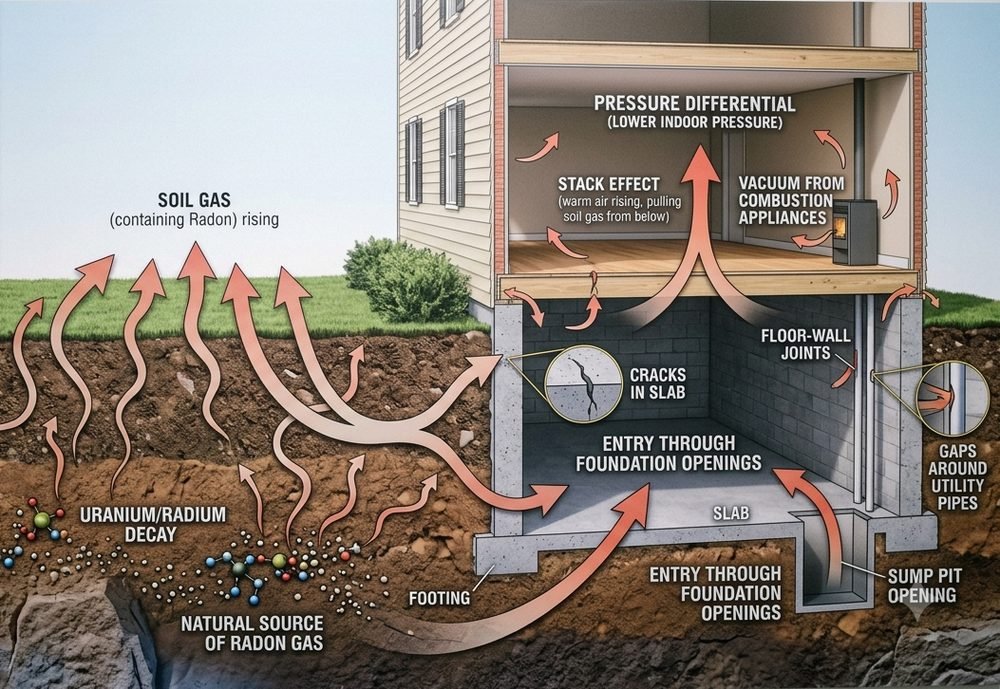
A complete installation also includes sealing major radon entry points — slab cracks, the sump pit, and floor-wall joints — and adding a system monitor, usually a simple manometer, so the homeowner can see at a glance that the fan is working. Every component is chosen for the specific home so the system is both effective and unobtrusive.
The Radon System Installation Process, Step by Step
A professional installation starts with a diagnostic assessment of the home — the foundation type, the sub-slab material, and the best location for the suction point and fan. From there, most installations are completed in a single day. The technician cuts the suction point, runs and seals the vent pipe along the planned route, mounts the fan in an unconditioned space, seals the entry points, and installs the system monitor.
Once the system is running, a post-installation radon test confirms the result. This follow-up test, typically with a continuous radon monitor, verifies that levels have dropped below the action level before the job is considered complete. A quality installation is judged not by the pipe on the wall but by the number on that confirming test.
Radon System Installation for Different Foundation Types
No two Syracuse-area homes are identical, and the installation is tailored to the foundation. A full basement with a poured slab is the most straightforward case for sub-slab depressurization. Homes with crawl spaces usually need sub-membrane depressurization, in which a sealed vapor barrier is laid over the soil and the system draws from beneath it. Older homes with fieldstone foundations, multiple additions, or a mix of basement and crawl space often need a multi-point system with more than one suction location.
Getting the design right for the foundation is what separates a system that quietly holds levels down for years from one that never quite performs. Certified installers evaluate each home individually and size the fan and suction points to match.
Related: Learn about our broader radon mitigation service, systems for new construction, and radon system repair and fan replacement.
Have questions before you commit to a system? Read our honest answers to common radon questions on cost, how systems work, and more.
Certified, Licensed & Insured Professionals
Radon mitigation in New York should be performed by professionals certified through the National Radon Proficiency Program (NRPP) or the National Radon Safety Board (NRSB) — the two EPA-recognized certification bodies. New York’s Department of Health maintains a list of certified radon mitigation contractors. Always confirm your provider is certified, licensed, and insured before work begins.
Searching for radon mitigation in your area? We serve homeowners across the Syracuse metro and Onondaga County.
Frequently Asked Questions
How long does a radon system installation take?
Most residential installations are completed in a single day. After the system is running, a post-installation test confirms radon levels have dropped below the action level before the job is considered finished.
Where is the radon fan installed?
The fan is mounted in an unconditioned space — typically an attic, garage, or on the exterior of the home — never in a livable area, so that any soil gas is vented safely above the roofline.
Will the installed system be noticeable?
A professional installation is designed to be as unobtrusive as possible, with vent routing planned around the home. Exterior runs and attic-mounted fans keep the visible footprint minimal.
Serving Syracuse and the surrounding Onondaga County communities including Cicero, Liverpool, Baldwinsville, Camillus, Manlius, DeWitt, Lysander, North Syracuse, East Syracuse, Skaneateles, and Fayetteville.
Where We Install: We install radon mitigation systems across Onondaga County, including Syracuse, Cicero, Liverpool, Baldwinsville, Camillus, Manlius, DeWitt, Lysander, North Syracuse, East Syracuse, Skaneateles, and Fayetteville. System design depends heavily on foundation type, which varies considerably between older city housing and newer suburban construction.