
Continuous Radon Monitor Testing in Syracuse, NY
Fast, certified radon testing you can trust — delivering tamper-resistant results with hourly precision. Licensed & insured.
Continuous Radon Monitor Testing in Syracuse, NY
The only way to know your home’s radon level is to test. Because Onondaga County is an EPA Radon Zone 1 area — the highest-risk designation — every home in the Syracuse region should be tested, regardless of age, foundation type, or whether a neighbor’s home tested low. Radon is invisible, odorless, and varies house to house. Certified professionals who provide fast, accurate radon testing across Syracuse and the surrounding towns.
What Is a Continuous Radon Monitor?
A continuous radon monitor is a calibrated electronic instrument that draws in air and measures radon concentration at set intervals — typically once per hour — throughout the test period. Instead of a single averaged number, it captures the full pattern of how radon rises and falls in a home across a day or more. That hourly detail is what makes a CRM the instrument of choice for professionals, home inspectors, and real estate transactions.
Most CRMs also record supporting data such as temperature, humidity, and barometric pressure, along with any movement or tampering with the device. When the test is complete, the monitor generates a time-stamped report showing the hourly readings and the overall average, all measured against the EPA action level of 4.0 pCi/L.
CRM Testing vs. Charcoal and Alpha-Track Kits
Passive test kits — activated charcoal and alpha-track detectors — sit in a home, absorb radon over time, and are then mailed to a lab for analysis. They are inexpensive and useful for a first look, but they return only a single averaged result, offer no protection against tampering, and add days of lab turnaround. For a do-it-yourself first check, a charcoal kit is a reasonable starting point.
A continuous radon monitor is different in three ways that matter. It is electronic and self-contained, so results are available immediately when the test ends rather than after a lab round-trip. It records hourly data and environmental conditions, giving a far clearer picture than a single number. And it detects interference — open windows, a moved device, an interrupted test — which is essential when a result carries real consequences, such as in a home sale.
Why Hourly Radon Readings Matter
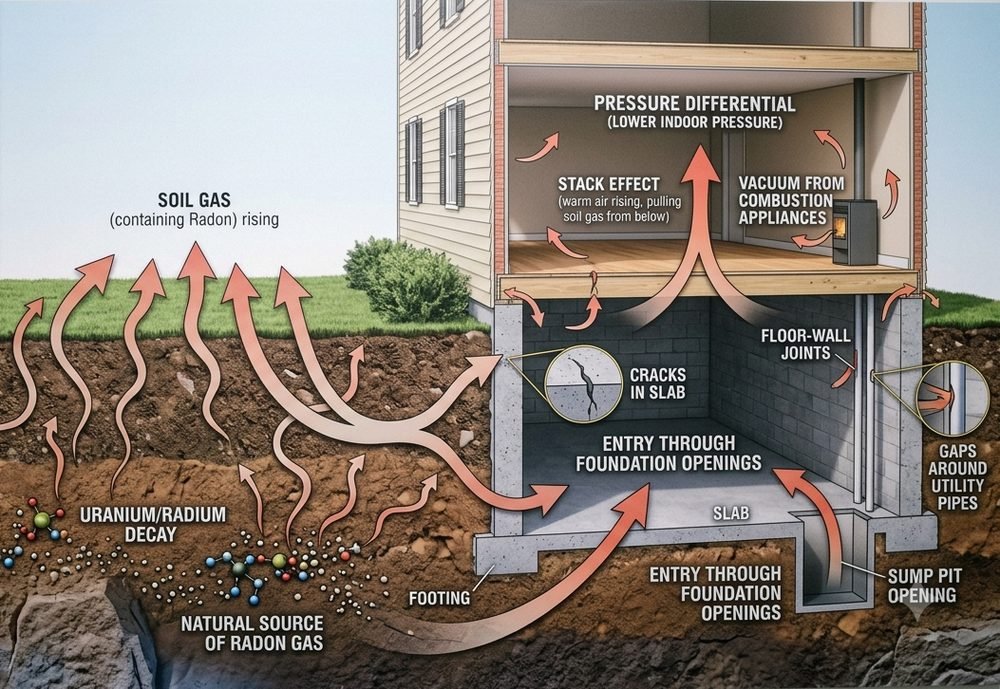
Radon is not constant. Levels swing with the time of day, the weather, and how a house is being used — typically rising overnight when a home is closed up and falling when doors open during the day. A single averaged result can mask those swings. In Central New York, where the freeze-thaw cycle and the winter stack effect drive radon upward, the hourly detail from a CRM shows not just the average but the peaks a family actually breathes.
Those hourly readings also validate the test itself. If a window was opened or the monitor was disturbed mid-test, the data shows it, and the result can be trusted or repeated accordingly. That reliability is exactly why continuous monitors are the standard for real-estate-grade radon measurement.
When CRM Testing Is the Right Choice
A continuous radon monitor is the best choice whenever accuracy and speed both matter. Real estate transactions are the clearest case: the tamper-resistant, time-stamped report a CRM produces is the standard both buyers and sellers rely on, and 48-hour results fit inside a tight inspection window. It is also the right tool for confirming a mitigation system is working, for re-testing after a questionable kit result, and for any situation where a defensible, professional measurement is needed.
For a routine peace-of-mind check where time is not pressing, a long-term test can also have value, since it captures seasonal variation. But when you need a fast, trustworthy answer — and especially when money or a deadline is on the line — CRM testing is the professional standard.
The CRM Testing Process
A certified technician places the monitor in the lowest livable level of the home and begins the test under closed-house conditions — windows and exterior doors kept shut except for normal comings and goings. The monitor runs for a minimum of 48 hours, recording hourly. Because it is self-contained, there is nothing to mail and no lab wait.
When the test period ends, the monitor is retrieved and a certified report is generated right away, showing the hourly readings, the overall average, and how the result compares to the 4.0 pCi/L action level. If the average is elevated, the same team can move directly into designing a mitigation system, and a follow-up CRM test confirms the fix worked.
Related: See our full radon testing service, learn how CRM testing supports a home sale, or explore radon mitigation if your levels come back high.
Want the plain-English version? See our answers to common radon questions, including how professional monitors compare to DIY kits.
Certified, Licensed & Insured Professionals
Radon testing in New York should be performed by professionals certified through the National Radon Proficiency Program (NRPP) or the National Radon Safety Board (NRSB) — the two EPA-recognized certification bodies. Always confirm your provider is certified before testing, so your results are accurate and accepted in a real-estate transaction.
Looking for radon testing in your area? We serve homeowners throughout the Syracuse metro and Onondaga County.
Frequently Asked Questions
What is the difference between a CRM and a radon test kit?
A continuous radon monitor is an electronic device that records hourly readings and detects tampering, giving immediate, defensible results. A charcoal or alpha-track kit returns only a single averaged number after a lab wait.
How long does continuous radon monitor testing take?
A CRM test runs for a minimum of 48 hours under closed-house conditions. Because the monitor is self-contained, certified results are available right away when the test ends, with no lab turnaround.
Is CRM testing required for a real estate transaction?
It is not legally required, but a continuous monitor is the preferred instrument for home sales because its tamper-resistant, time-stamped report is trusted by buyers, sellers, and inspectors alike.
Serving Syracuse and the surrounding Onondaga County communities including Cicero, Liverpool, Baldwinsville, Camillus, Manlius, DeWitt, Lysander, North Syracuse, East Syracuse, Skaneateles, and Fayetteville.
Where We Test: We provide continuous radon monitor testing across Onondaga County, including Syracuse, Cicero, Liverpool, Baldwinsville, Camillus, Manlius, DeWitt, Lysander, North Syracuse, East Syracuse, Skaneateles, and Fayetteville.