
Certified Radon Testing & Mitigation in Cicero, NY
Licensed, insured, and local. Serving Cicero and all of Onondaga County — an EPA Radon Zone 1 area.
Radon Mitigation & Testing in Cicero, NY
Cicero sits at the north end of Onondaga County along the Route 11 corridor and the south shore of Oneida Lake — and like the rest of the county, it’s an EPA Radon Zone 1 community, where indoor radon is predicted to average above the 4.0 pCi/L action level. Cicero has seen heavy residential growth over the past two decades, which means a mix of century-old farmhouses, 1970s–90s homes, and brand-new subdivisions off Route 31 and Bartel Road — and radon can be elevated in any of them, regardless of age.
Certified radon testing and mitigation is available throughout Cicero, including the Brewerton area, South Bay, and the newer developments north of the village. Newer construction here often has full basements built into the region’s glacial till, which can act as a direct pathway for soil gas; older homes may have fieldstone foundations, sumps, and crawl spaces that need a tailored mitigation approach. Certified professionals evaluate your specific foundation and design the right system for it.
Why Cicero Homes Test High for Radon
Cicero occupies the flat ground between Syracuse and Oneida Lake, and that flatness is the clue to its geology. This is the bed of glacial Lake Iroquois, the much larger predecessor of Oneida Lake that covered the area as the last ice sheet retreated. What it left behind is a plain of lacustrine sand, silt, and fine-grained deposits lying over glacial till and, below that, the same trace-uranium-bearing sedimentary bedrock found across Onondaga County.
The distinguishing feature here is not the rock but the water. Cicero has a notably high water table, and Cicero Swamp is the visible surface expression of a condition that extends well beyond the wetland boundary. Radon behavior in this setting is governed by saturation. When the water table is high in spring, saturated pore space physically blocks soil gas from migrating, and readings tend to be suppressed. When the table drops through late summer and autumn, those pathways open and gas moves freely toward foundations.
The practical consequence is that Cicero produces some of the widest seasonal swings in the county. A home that tests at 3 pCi/L during a wet April can test well above the action level in a dry October, with nothing about the house having changed. Homeowners here should be more skeptical of a single reassuring short-term result than homeowners elsewhere in Onondaga County.
Cicero Sits in an EPA Radon Zone 1 County
Every part of Onondaga County, Cicero included, carries the EPA Radon Zone 1 designation. That is the highest of the agency three risk categories, applied to counties where the predicted average indoor screening level exceeds the 4.0 pCi/L action level. It is a statement about the county as a whole rather than a prediction for any single address.
The measured figures behind that designation come from the Onondaga County Health Department, which reports an average basement level of 8.1 pCi/L, and from testing showing that close to half of homes screened countywide exceed 4.0 pCi/L. The New York State Department of Health puts the statewide figure near 18 percent, so Onondaga County runs at roughly three times the state rate.
None of these numbers describe a specific Cicero property. Given the seasonal variability the local water table produces, they are best treated as a reason to test rather than as an estimate of what a particular home will measure.
Cicero Housing Stock and Radon Entry Points
Cicero has grown faster than most of Onondaga County over the past few decades, and the housing reflects that. Subdivision development along the Route 11 corridor and outward from Brewerton has added a large volume of construction from the 1990s onward, much of it on full poured concrete basements over engineered fill.
Newer construction carries a specific radon disadvantage that homeowners often find counterintuitive. Tighter building envelopes, better weatherstripping, and higher insulation standards all reduce the rate at which indoor air exchanges with outdoor air. Less exchange means less dilution, so radon entering a modern Cicero home accumulates to a higher concentration than the same rate of entry would produce in a drafty older house. New does not mean low.
Alongside the subdivisions, Cicero retains a substantial stock of farmhouses and rural properties on the roads running north and east toward Oneida Lake and the swamp. These older homes often have stone or block foundations, partial basements, or crawl space sections, and many sit on private wells rather than public water.
Private wells introduce a second exposure route that most of Onondaga County does not need to consider. Radon dissolved in groundwater is released into indoor air when water is agitated, which happens most during showering and laundry. Waterborne radon is a smaller contributor than soil gas in nearly all cases, but on a rural Cicero property with a drilled well it is worth including in the assessment rather than assuming the slab is the only pathway.
Radon Mitigation in Cicero
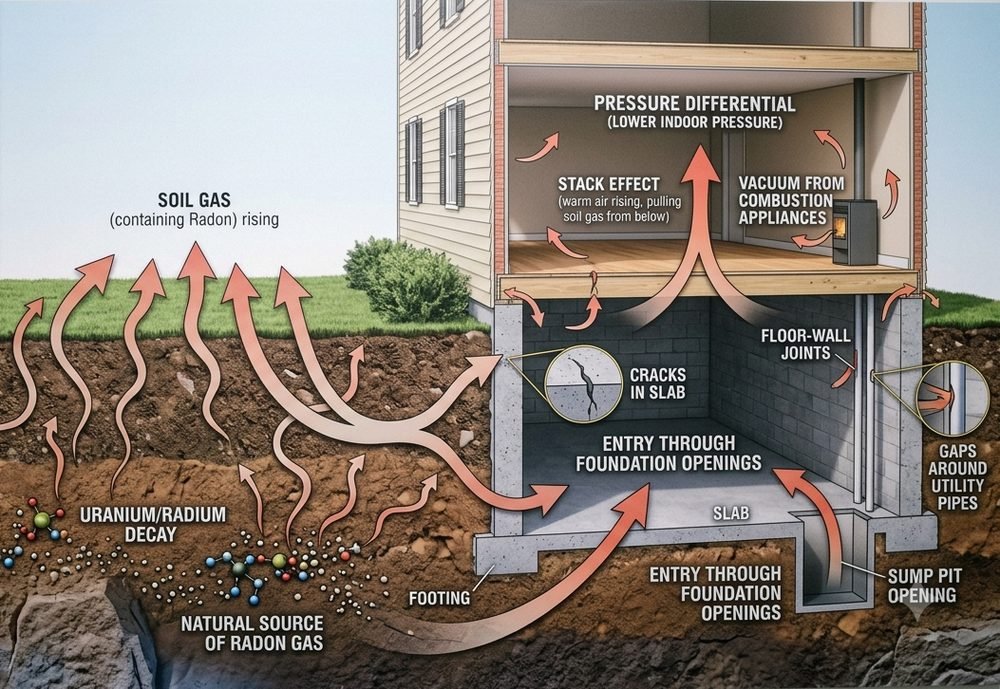
The standard, most effective fix is active sub-slab depressurization — a sealed vent and in-line fan that pulls radon from beneath the slab and exhausts it above the roofline. Most systems install in a day. Cost depends on the home’s foundation type and system complexity — we’ll give you an exact figure in a free, no-obligation quote. depending on foundation and complexity.
Newer Cicero homes are usually straightforward to mitigate. A sound poured slab over permeable fill is close to the ideal case for sub-slab depressurization, and one properly placed suction point commonly serves the whole footprint.
The high water table introduces a design consideration that does not arise elsewhere in the county. Where groundwater sits close to the underside of the slab, a system pulling too aggressively can draw moisture rather than soil gas, and sump pits require sealed, gasketed covers with proper drainage so the mitigation system does not compete with the pump. Both issues are manageable, but they need to be identified during the site visit rather than after installation.
Older farmhouses with partial basements or crawl space sections often need a sealed membrane across exposed soil, tied into the same fan and vent stack serving the slab portion. Mixed foundations of this kind are common on Cicero rural properties and are the main reason estimates vary here.
Radon Testing in Cicero
We use continuous radon monitors for fast, accurate, tamper-resistant results in about 48 hours — important for both peace of mind and real-estate timelines, since New York addresses radon on its Property Condition Disclosure Statement.
Because of the seasonal swing driven by the water table, timing deserves more thought in Cicero than in most of the county. A short-term test taken during a wet spring may understate what the home produces the rest of the year. Where a decision is not tied to a closing deadline, a long-term test of 90 days or more gives a far more trustworthy picture here.
For rural properties on private wells, water testing is a separate procedure from air testing and requires a sample sent to a laboratory. If your Cicero home draws from a drilled well and the air test comes back elevated, the water is worth checking as a possible contributing source rather than assuming the soil accounts for all of it.
Selling a Cicero Home
New York Property Condition Disclosure Act requires sellers of residential property to report known radon test results and any mitigation work on the disclosure statement.
Cicero sellers face a particular version of this because of seasonal variation. A favorable spring test does not guarantee a favorable result if a buyer tests in October, and a discrepancy discovered mid-transaction is a difficult conversation. Testing early, and ideally testing long-term, gives a seller a defensible number rather than a lucky one.
Areas We Serve Around Cicero
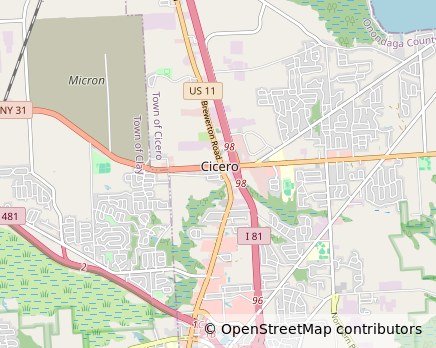
We provide radon testing and mitigation is available throughout the Town of Cicero, including Brewerton, North Syracuse, Bridgeport, and the neighborhoods along Route 11, Route 31, and Thompson Road, as well as rural properties bordering Cicero Swamp and the south shore of Oneida Lake. We also serve nearby Liverpool, DeWitt, and the city of Syracuse.
Frequently Asked Questions
Is radon common in Cicero, NY?
Cicero is in Onondaga County, an EPA Zone 1 area — the highest-risk category. Elevated radon is common; testing is the only way to know.
How much is radon mitigation in Cicero?
Cost varies with foundation type and system complexity depending on your home. We estimate before any work.
Can you test newer Cicero homes?
Yes — new construction can have elevated radon too. We test homes of every age.
Serving Cicero and nearby Liverpool, Baldwinsville, and the northern Onondaga County towns.
Helpful reading for Cicero homeowners: DIY kits vs. professional testing, radon in new construction homes, and radon levels by zip code.